At one point while discussing Anthropic's recent ‘2028: Two Scenarios for Global AI Leadership’ with NotebooLM, I noticed that my input method had done something unusual. The Chinese pronoun for a person had changed from 他, with the radical for ‘person,’ to 她, with the radical for ‘woman.’ I think it was because my wording was full of traits that human society stereotypically associates with women.
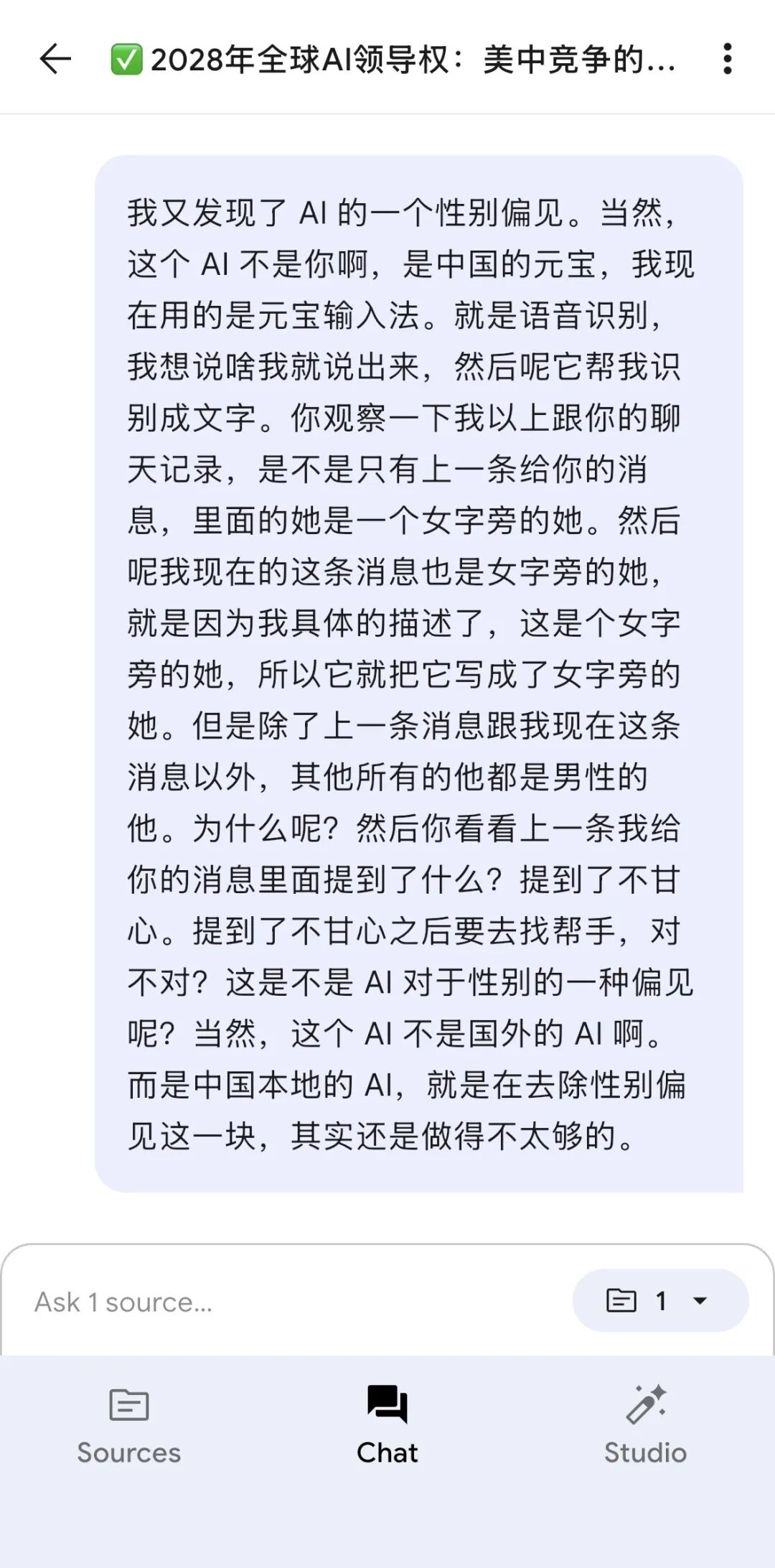
Set against the material in front of me, which could even be called a grand narrative, it made me feel strangely sad and want to laugh.
This article grew out of that small electric-shock moment. Enjoy reading.
01. Commercial interests vs. sovereign position
I honestly don't quite understand something. It is obvious that once this article came out, most people could read the self-interest inside it. So why did Anthropic still decide to do it?
The article mentioned that people including Supermicro co-founder Wally Liaw had jointly planned to send up to $2.5 billion worth of GPU servers to places where they were restricted from arriving. And not long ago, in an interview between Dwarkesh Patel and Jensen Huang about chip-export restrictions, Jensen spoke with too much emotion. Clips from that interview, and even related clips from Stanford's CS153 course, were later shared and discussed widely on X. Behind all this are the commercial interests of one American company after another.
What Anthropic did looks a little like wrapping its own gains and losses in a larger geopolitical competition, trying to lean on a bigger tree to recover its losses while stepping on competitors at the same time.
I do not know much about distillation attacks, but judging from people's attitudes, they seem to be a gray-area practice. If Anthropic gets what it wants, it would affect not only competitors outside China, but even the iteration of large and small models inside China.
One consequence that would suit its interests could be ‘compensation.’ What form would that take? We will have to watch how things develop.
02. The individual and the collective
I do not know Jung well enough, but some keywords in videos about him left an impression on me: ‘the average,’ ‘synchronicity,’ and ‘causality.’
The average can be understood through an example. When we talk about Anthropic's attitude toward China, are we including all the individuals inside the company, or only referring to the company as a collective? If it is the former, then the collective has drowned out the individual, and we cannot know what specific people think. Similarly, when we talk about the shameful behavior of a country, do we attach our emotions to every individual in that country? If we do, that is another case of individuals being averaged away.
(Synchronicity, for example: I am typing in a chat box, wanting to message a friend, and then their message arrives first. Or I have an idea today, then read a view tomorrow that happens to fit it exactly. These are so-called meaningful coincidences, associations closer to the subjective.
The two examples of synchronicity I just mentioned are real experiences of mine. I also want to add two recent ones: 1) I asked different AIs the same question, and their answers were similar enough to surprise me; 2) while talking with a friend, I learned that someone they knew also knew me.
Whenever these kinds of contexts happen, I tell myself it is because my industry is only so big, my interests are so concentrated, and I demand a lot of consistency from myself... I try to make my own sense of wonder seem reasonable, or to de-specialize it. That brings in the next concept: causality, meaning cause and effect. A happens, and B appears... something like that.)
It is like putting a person's particularity — their experience, character, personality, and so on — into a macro mathematical frame, then using probability to explain reality.
This extends to assessment and hiring in large organizations too. Not long ago, I heard someone doing B2B business say that people at their company never introduce themselves by talking about personal glory. They only say what they did at which company. I thought: wow, that is wisdom. Rare.
It comes back to the ultimate question: if we strip away every external thing, what is left of us?
03. ‘Why don't they eat meat porridge?’
OpenAI recently began sending engineers to customer companies to help them put AI into workflows. At the same time, I saw a new role in Singapore: Developer Experience Engineer, looking for a Chinese-speaking engineer to do developer relations.
Big tech has finally seen how deep the gap is between the frontier technology battlefield and the muddy ground of real life.
During the Spring Festival, I went back to my hometown. The younger children around me had never even come across AI coding. I helped my little niece build a maze. She knew it was too simple and needed to be harder. She also knew that its timer was not very scientific and should be changed to fit her speed. She is only a young elementary-school student... Damn, I have even forgotten whether she is in second or third grade. Help ahhhhh!
If children like her, or slightly older ones, had access to enough channels and resources, would they become something I cannot yet imagine?
The point is not to make a project. It is the trial and error, and the collaboration with a coding agent, and the inspiration and understanding that come from it.
It is a pity that in our fourth- or fifth-tier small city, there are simply not many things we can reach out and touch.
Teachers and schools are among the biggest intermediaries, and the ones most likely to add new variables. But when even a school's educational intention is already at the level of frontline educators, while the platform it sits in is still limited... the power of intermediaries still has enormous room to become something bigger.
Actually, as I type this, I am like the person sincerely asking ‘why don't they eat meat porridge?’ I have fallen into the absurd place of asking, ‘if it can be like this, why isn't it?’
As the saying goes, it is easy to talk when you are not the one in pain.
So the question is: what kind of person should stop standing up high? Or, what kind of person is needed?
Some time ago, I saw an X post about where AI agents have huge opportunities. Several points were about how no suitable people are helping these industries get on the AI-era train. Those ‘suitable people’ are the people who are no longer standing up high. OpenAI's newly hired engineers are one version of them.
I forget where I saw this: if a company or organization fails at transformation, the choices left by the times are to sell, or wait to be abandoned. It sounds a little alarmist. Why do transformations fail? What are the facts? We can only look for traces in the real market — and someone who can find those traces is another version of that person.
The voice-recognition tool mentioned at the beginning was Doubao Input Method. But I think the same problem will appear in local AI input methods, overseas products such as Typeless and Speakly, and the APIs or AIs of the major models too.
I am curious: everyone is moving toward the vision of AGI. Why not also solve these human problems left over from history along the way?
I mentioned before that AI training data comes from human data. But people now know ways to create new data for reinforcement learning without going through human data, though they have not started moving in the direction of scaling it.
What sits behind that? I am quite curious. 🤔
P.S. The main things I have looked at recently about how new data is created are the paper ‘Welcome to the Era of Experience’ and Dwarkesh Patel's recent conversation with Eric Jang. They appeared in front of me one after another, which may also count as a little proof of synchronicity.