I recently heard two ideas that I found interesting and wanted to keep, so here I am writing again.
01. Wrong information has value too.
This came from Wang Guoping, the founder of the AI education company Indievolve. What he actually said was that coming across even one wrong piece of information is better than knowing nothing at all.
1) Skin in the game
On March 24, I was talking with Poke. It mentioned that Azeem Azhar had run an experiment: he used AI to analyze 140 million jobs across 25 countries in 15 minutes, trying to measure AI's impact on the labor market. The result was striking, but he eventually decided not to publish it.
On the other hand, Andrej Karpathy had done something similar as early as March 15. He spent two hours vibe coding a labor-risk assessment tool. Using U.S. Bureau of Labor Statistics data, it scored 342 occupations from 0 to 10 for AI exposure, covering around 143 million U.S. jobs.
In fact, Azeem was inspired by Karpathy to run that experiment.
The difference was in the countries and occupation data they chose, and also that one chose not to publish while the other did.
After Karpathy published his results, the reaction on social media — beginning on X — was quite intense. People even pushed him to delete the data.
But he later chose to keep it public, while adding limits around the data sources and key takeaways.
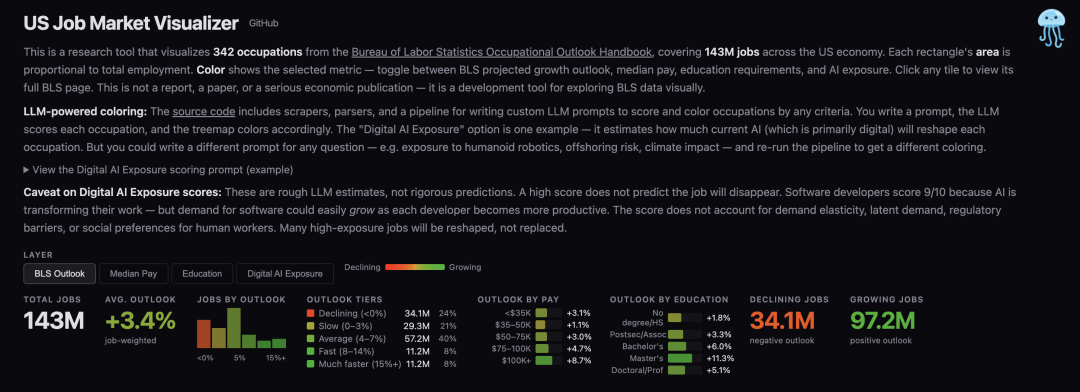
Honestly, I am very curious what Azeem found that made him not dare to publish it.
Publishing data without professional endorsement does carry a public-image risk. But saying that information and analysis come with consequences, then withholding the data while still letting people know, ‘I did this, but I decided not to publish it’... I feel there is some invisible gap there.
There is another reality: if Poke had not told me about it, I would not have known. I was not scrolling X much then, and I did not see posts like this on Xiaohongshu either, even though I often see AI and technology information whenever I open it.
So who are the people who took part in, and witnessed, those waves of attention?
Karpathy's results: https://karpathy.ai/jobs/
2) ‘People might panic’ vs. ‘people did panic’
The last time I was in Osaka, I felt an earthquake in my body. It was exactly like the dizziness I feel on a carousel: the world spinning, things around me moving. Only afterward did I learn that there had been an earthquake in central and northern Japan, and its aftershocks reached where I was.
Later I saw a post on Xiaohongshu saying: it was strange — some people had already run out of their hotel, only to find that local people did not react at all.
Well, the earthquake is not the point. I want to use it to move toward tsunami warnings.
I want to invite anyone reading this to try a small experiment. Among the following true events, one was called ‘panic’ by officials and the media. Let's guess which one.
A. A ten-year-old girl on a hotel beach felt that the sea was ‘starting to become strange’ and told her mother, ‘I think a tsunami is coming.’ Her mother and hotel staff urged other visitors to leave the beach and move to higher ground. They did.
B. A group of Japanese tourists on a beach noticed that the tide seemed to have gone unusually far out. They thought it could be a sign of a tsunami, and other tourists followed them to higher ground.
C. People in coastal areas of southern India, Thailand, and Sri Lanka received government warnings that another tsunami might happen. Tens of thousands of people fled to higher ground.
A and B happened on December 26, 2004, when a 9.2-magnitude earthquake at the boundary of the Indian and Eurasian plates caused a tsunami that killed around 230,000 people. C was reported three days after that tsunami — and it turned out to be a false alarm.
The answer is C.
Some media outlets, and even officials, called C ‘panic,’ with headlines such as ‘False tsunami warning causes panic in India’ and ‘Tsunami warning causes panic, but no losses.’ By contrast, reporting on A and B was moving, even encouraging.
But if A and B had not been followed by a tsunami, while C had correctly warned of one, how would the reporting have changed?
One fact from that devastating event is that Thailand's meteorological department knew about the Sumatra earthquake an hour before the tsunami arrived. After an emergency meeting, it decided not to issue a tsunami warning because it feared panic.
As a result, around 80,000 of the nearly 230,000 deaths happened near the coast.
There are similar comparisons: in the 1993 Japan tsunami, a warning came within 10 minutes of the earthquake. Together with tsunami education and evacuation plans, the death rate was around 15%. In the 1998 Papua New Guinea tsunami, there was no warning system, no education, and no evacuation plan; the death rate was around 40%.
Links: 1) https://www.psandman.com/col/tsunami1.htm 2) https://www.tsunami.noaa.gov/tsunami-story
02. Doing social media is part of making information more equal
This came from Xu Huazhe, an entrepreneur in embodied intelligence and the founder of Poke Robotics. For him, it is one way to pursue what he wants to do with his life.
He said that, in some ways, he is someone with informational privilege. By doing social media, he can share knowledge from his research field, help more people understand embodied intelligence and what sits behind scientific research. Maybe people doing the same work can know what he shares and do even better than him.
Even though sharing is selective, that open sincerity moves me.
1) I don't know what I need to know
I was born in a very information-closed small place. Only through studying could I see a larger world. At every turning point on that path, information found me, and I was lucky enough to catch it.
I understand deeply that someone who does not know what they do not know cannot know whether they need to know something — because they do not even know what that ‘something’ is.
But I do not think that not expressing a need should automatically mean there is no need.
The first time I went to Seoul was for a music festival. After it ended, everyone hurried home, and it was already after nine at night.
Following the crowd to the subway station, staff were there all along the way, ‘watching over’ us. There were also a few staff in plain clothes at the entrance keeping order.
When the train started, the carriage was packed. But when I looked up, the priority seats were empty. Empty?!
Do you know? In that moment, my brain completely forgot how it was supposed to react. In my country, this would not happen.
I cannot speak for other carriages, but the one I was in was full of young people, all festival listeners.
For a moment I even thought: wow, this is strange. No one needs those seats right now, so why are people standing while they stay empty? Sitting first and giving them up when someone who needs them gets on is also an option, isn't it?
That is understandable in the culture I grew up in.
Later I realized that I like this sense of order very much.
Here, some needs do not become unseen because the people who have them are not present. Or rather, a person's absence does not make their needs disappear.
2) Information being present, and absent
I briefly worked in education. With no formal background in it and no direct senior mentor, I had to figure out almost by myself how to become a qualified educator. Then I found that truly good learning resources are either behind paywalls, outside walls that most people cannot reach, or only partly reachable through reliable school resources, such as resources from partner schools.
What about frontline teachers who also want to learn how to be good teachers but have no path to do so?
Being an educator is not only owning a job. It is also about how to be a lifelong learner. To do that, self-drive matters far less than having wide, easy-to-reach paths to resources.
And this kind of information often has to be fought for by people who are already present, rather than being present on its own.
(About the saying I have seen before, ‘a group of teachers who do not learn leading a group of students to learn’: whatever the internal situation is, I think absent information should bear some responsibility too.)
I feel that it is exactly because some people generously share industry knowledge and information from their fields that more people have a direction, and more confidence, about how to walk their own path and walk it well.
But what if information from someone misleads people?
My view is that it is not only that ‘wrong information has value too.’ We also need to consider why that person shared it, where their information came from, and what the consequences of the misleading were... There are too many parts to settle in a few sentences.
When Karpathy shared information from that tool, he did not expect it to cause such a large reaction, or even to be taken out of context, to the point that he was pushed to delete the data.
But do you think anyone was affected by that data?
The more specific data is not available.
But more importantly, the data was kept in the end. Later, someone might use it to predict how much AI will affect their field or work, and make plans earlier.
I also wonder whether the appearance of this data could help professionals or relevant departments prepare, and plan earlier for how society should operate if the future suggested by the data becomes real.
Whether the future comes true or not, Karpathy had skin in the game.
P.S. Thank you to Poke for mentioning Azeem's story in our chat; thank you to Claude for helping me find tsunami material; thank you to Teacher Wang and Teacher Xu for sharing; and thank you to myself for connecting all these messy feelings and inspirations into this article.