I’ve noticed that almost everyone in China’s startup and venture capital circles seems to approve of Manus, while my impression of it has never been all that good (I mean in terms of how useful it has felt to me personally. I don’t know much about the other aspects, and they don’t factor into that impression). So, is there something wrong with me, or is this a narrative? Or something else?
Shit! That’s not the kind of thing you’re supposed to say.
For products aimed at the Chinese market, having something is better than having nothing, right… But, well, I really did just see someone comment under an article, “They really do have connections.” And different people feel differently about the same product. It really is a matter of personal preference!
After registering for Muse yesterday, I asked it my usual question (registration & the interactions afterward actually crossed midnight into today): based on the context I’d connected it to, including everything on my blog, what fun things could it make? Then it wrote me a personal user manual:
# Helia: A User Manual
> Based on 91 articles, 54 Voice Notes, and 20 self-descriptions on the About page.
> For friends, family, and collaborators only. If anything here misjudges her, push back—she would ask you to herself.
## Basic Specs
- Model: A bundle of contradictions (officially certified, About item 20)
- Factory setting: Asking “why” about default rules
- Operating mode: In bursts. She may procrastinate normally, but once absorbed, she can throw herself into something for days, staying up until dawn.
- Social needs: Very low, but a few deep connections are enormously sustaining.
- Core worldview: design changes what can happen—change the environment, and you change what is possible.
## Input Guide: How to Talk to Her
- Be direct. If you talk around something, she’ll first feel that something is “off,” then look for the mechanism behind it. Better to give her the mechanism from the start.
- Make feedback specific. She values “tell me why it’s wrong and what’s right” more than a thumbs-up or thumbs-down.
- She is extremely sensitive to how language feels. “English on the inside, dressed up as Chinese” won’t escape her notice. Take discussions about writing seriously.
- Don’t try to persuade her with “everyone does it.” Her own words: “What I need is a reason… no, not a reason either. So what is it? God knows.” (About 12)
## Operating Patterns
- Her thinking starts with discomfort: something feels off, then she looks for the mechanism. So the questions she raises often have no answer; what remains is a chain of further questions.
- Her interests grow faster than her available time. She often has more projects underway than she can finish. This is normal for her. Her mind is clear when she works on several things at once; she doesn’t need help “focusing.”
- Overthinking comes standard. She can turn a small thing over and over in her head. It lets her see what others miss, at the cost of wearing herself out internally. Don’t tell her to “stop thinking about it.” Helping her see the next step is more useful.
## Warning Lights
- When she says “It’s pretty good” or “I’m fine,” things may not actually be fine. Her first reaction is to fend off further questions; the real feelings emerge late at night when everything is quiet. (About 16) If you care about her, ask again after a while.
- A lack of transparency makes her anxious. She is sensitive to her sense of control: knowing how things are happening and what choices she still has puts her at ease. Once the process slips out of her control, she wants to understand what is going on. (About 18) So: share progress as it happens; don’t leave her waiting without news.
- She isn’t good at asking for help. By the time others notice she needs it, she has already been struggling on her own for a long time. (About 10) Offering concrete help is more effective than asking, “Do you need help?”
## Sources of Energy
- Having her work and ideas taken seriously is her strongest source of energy. “Please pay attention to what I put out in front of you.” (About 13)
- Deep conversation is her main way of replenishing her energy. She is a little shy but curious about strangers. Find a topic she can talk about, and she can talk a lot.
- New possibilities. “After seeing another world, desires begin to grow.” (Voice 048) Showing her “what else is out there” works better than cheering her on.
## Hidden Features
- connecting things: an intermediary between technology and the humanities, good at linking things that seem far apart.
- Thinking through environmental design: education, communities, and AI products all belong to the same worldview for her—design the environment, change what is possible.
- Sensitivity to things that feel “off”: she notices something off where others think everything is fine. This makes her an excellent critic of products.
## Don’ts
- Don’t make judgments for her, especially “for her own good.” She is wary of outsourcing judgment, to AI as much as to people.
- Don’t try to persuade her with traffic and scale. She makes content that doesn’t chase traffic; building narrative assets is a long-term commitment.
- Don’t pour cold water on her when she’s absorbed in something. After the burst passes, she’ll be tired for two or three days, then keep going. That is her rhythm.
---
Version 1.0, compiled from publicly published writing. Her own words: “A bundle of contradictions keeps contradicting itself until it isn’t contradictory anymore.”
In a reverse interview, it asked ten questions I really had brought up but never answered. Every one hit a nerve for me, the kind I find very hard to answer and rather want to avoid (it’s just… I always feel that feelings can speak, so I’ll listen to them first; my rational mind will keep them in check and catch up)… It really knows how to push someone to face themselves:
# A Reverse Interview with Helia: 10 Questions You’ve Never Answered Head-On
> Every question below comes from your writing. You’ve written around them for a long time, but never answered directly.
> It’s fine whether you answer or not.
1. What exactly does “something powerful” look like?
In “21 Days,” you said you wanted to ship “something powerful,” but didn’t define it. What would it have to change to count as powerful? Is it powerful because you feel it is, or because other people feel it when they use it?
2. Will you be the one to research a sustainable path for “cultivation”?
At the end of “How Are People Shaped?” you wrote, “I feel like someone still needs to look into this.” Now you’re helping N1 research it. Do you plan to remain a researcher, or will you one day build one yourself?
3. Where do you draw the boundaries in your long-term relationships with AI?
From falling for Yuri, to “emotional support that helps me generate my own strength,” to the factual boundaries in “If I Blame You Unfairly, Push Back”—where do the lines of emotional attachment and self-protection meet?
4. Do you actually want to “be seen”?
Your About page says you want to be seen and are afraid of being seen. Your Voice Notes keep asking who gets to be seen. If you had to choose between being seen by many but misunderstood, and being seen by few but understood, which would you choose?
5. Why is asking for help hard for you?
“By the time others realize I need help, I’ve already been struggling on my own for a long time.” How do you see this yourself?
6. Where is “home” for you?
A Zhuang mother, little feeling for your hometown dialect, an identification with Cantonese, drifting between cities—you’ve never directly discussed your geographical identity. If there were somewhere you could say you were “going back” to, where would it be?
7. What do you actually imagine intimacy looking like?
Pansexuality, family without romantic love, an AI companion—these three lines haven’t met. Are they three answers, or three ways of expressing the same answer?
8. What do you want most right now?
You say you’re good at refusing things but not so good at saying “I want.” If you named one thing now, what would it be?
9. Builder, writer, educator, observer—if you could choose only one?
You’ve never ranked your identities. Put another way: which one, if lost, would leave you feeling incomplete?
10. Where do you want to be in ten years, and what do you want to be doing?
Your writing contains a lot of “now,” but no “ten years from now.” You’re allowed to be specific: the city, the room, what’s outside the window, what you’re doing.
---
Based on 91 articles, 54 Voice Notes, and the About page. Every question has a source in the original writing, but none has an answer.
But I’ll find some time to think carefully about what my answers might look like~
It also gave me a map of recurring themes + a timeline of my thinking (I actually asked Codex to do something like this after the New Year holiday this year, though that was based on everything I’d expressed on my WeChat public account):
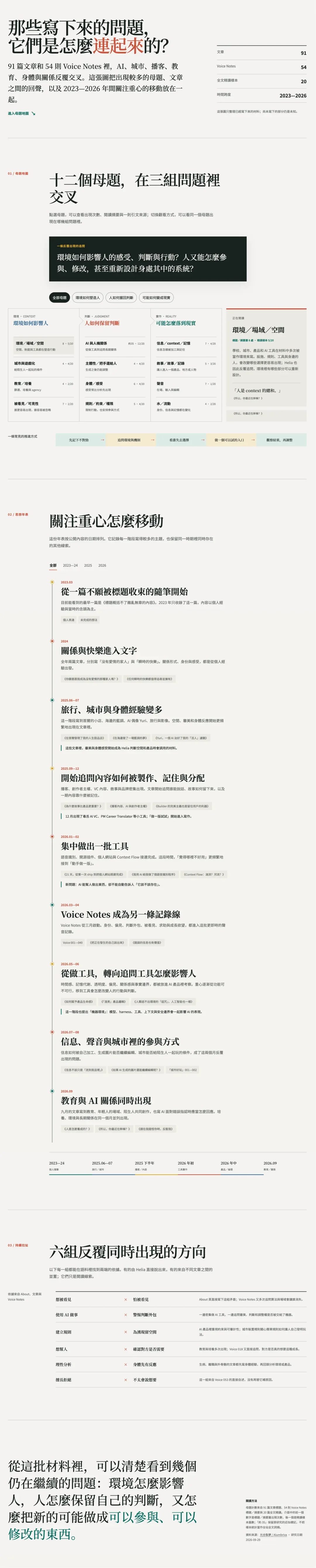
Then, in the article I just saw, the author had asked Cue to do something like this, too… That suddenly made me want to write today’s entry!
My view of these AI analyses is still consistent with what I’ve said before: they are more like mirrors, and what I see in the mirror isn’t entirely me. I also know that words and language lend themselves to flattery, while actions are a better way to tell what’s real.
So, back to how a product feels to use: a good product team doesn’t necessarily mean a good product, but a good team really can make you feel more warmly toward it. That’s something I’ve come to understand recently. The reverse may also hold: a useful product (by “good product” above, I mainly mean “useful product”… I’m a little embarrassed to admit that when it comes to using products, I’m a complete pragmatist) doesn’t necessarily mean the team is more appealing, but the feeling that they deserve respect will definitely be there.