If you’ve opened this article, please read all the way to the end.
Women’s health and the digitization of health data are blue-ocean markets.
That’s what I took away after recently working on a podcast episode. It’s the latest episode of The Gaia Project (盖亚计划). It hasn’t been released yet, so here’s a little preview—stay tuned!
The two guests are Leah and Lily. Leah started The Gaia Project; Lily is a woman who worked in investment banking in New York and is now a medical-device entrepreneur (MinaRosa).
This episode connected some memories from the past with things I’ve heard recently.
First, MinaRosa’s starting point was the question of how to solve antibiotic resistance in patients with urinary tract infections after long-term antibiotic use, with the goal of improving patients’ everyday experience.
I first heard the term “urinary tract infection” from a friend who had this problem. Before I met her, I knew absolutely nothing about it. She only told me that it meant frequent trips to the bathroom, and that the treatment was antibiotics.
Second, I’ve been learning about VC-related content lately. A friend recommended their podcast, and I listened to an episode where they talked with a friend who worked at a VC firm but had quit without another job lined up to start a company. The guest said, “And this is something only women / only I can do.” She was starting a condom company. It’s true that when it comes to bodily structure and experience, women understand women better.
Then my roommate complained to me: Someone is making a YJ prosthesis that can be implanted in men’s bodies, so why has no one looked into how to solve menstrual pain for women? Menstrual pain is something I’ve watched friends around me suffer from since middle school. Because of my own body, I had never personally felt how painful it was (even after my physical condition declined and I felt some discomfort, it was still only mild). It wasn’t until she complained that I realized: Oh, right. Why does this keep happening without any relatively good solution? And with AI developing and flourishing so quickly in recent years, I haven’t even seen a corresponding project in my field of vision. Or are people still preparing?
I don’t know. I’m really looking forward to it!
I just feel that what Lily is doing is truly wonderful, and that she’s making an enormous contribution to advancing women’s health. The episode also mentioned a concept called “Pilot Study.” In the Chinese context, it means “beta testing.” That made me think about digitizing women’s health data. I have a feeling that the Chinese market really hasn’t done enough in this area (surely it isn’t simply that I haven’t noticed it yet / don’t need it yet, so I’m not paying enough attention, right?). This is very important and necessary for women. (A pure blue-ocean market!
Then I asked ChatGPT, and it gave me some ideas that I thought were worth considering! I won’t go into the details here; if you’re interested, look at the images below.
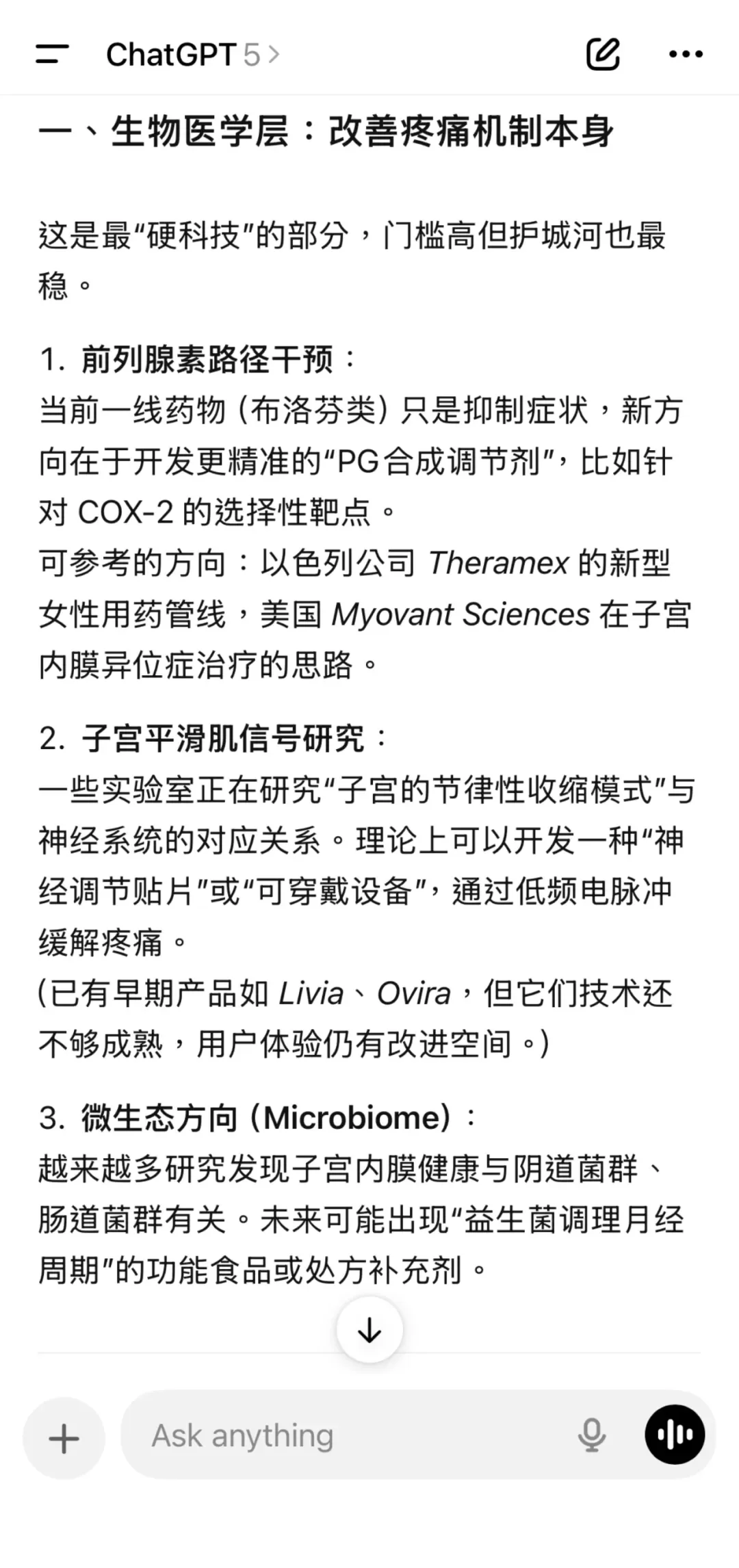
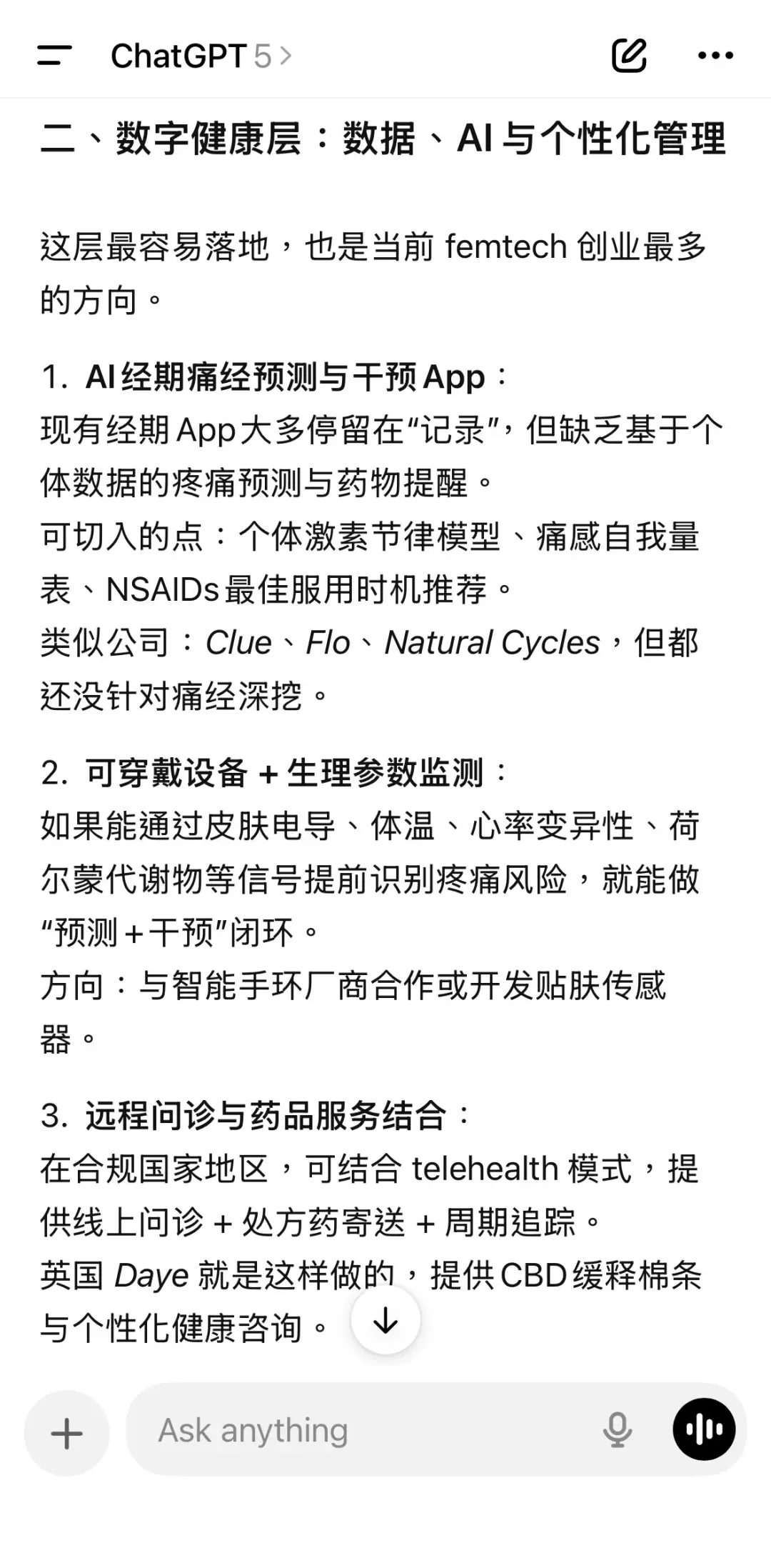
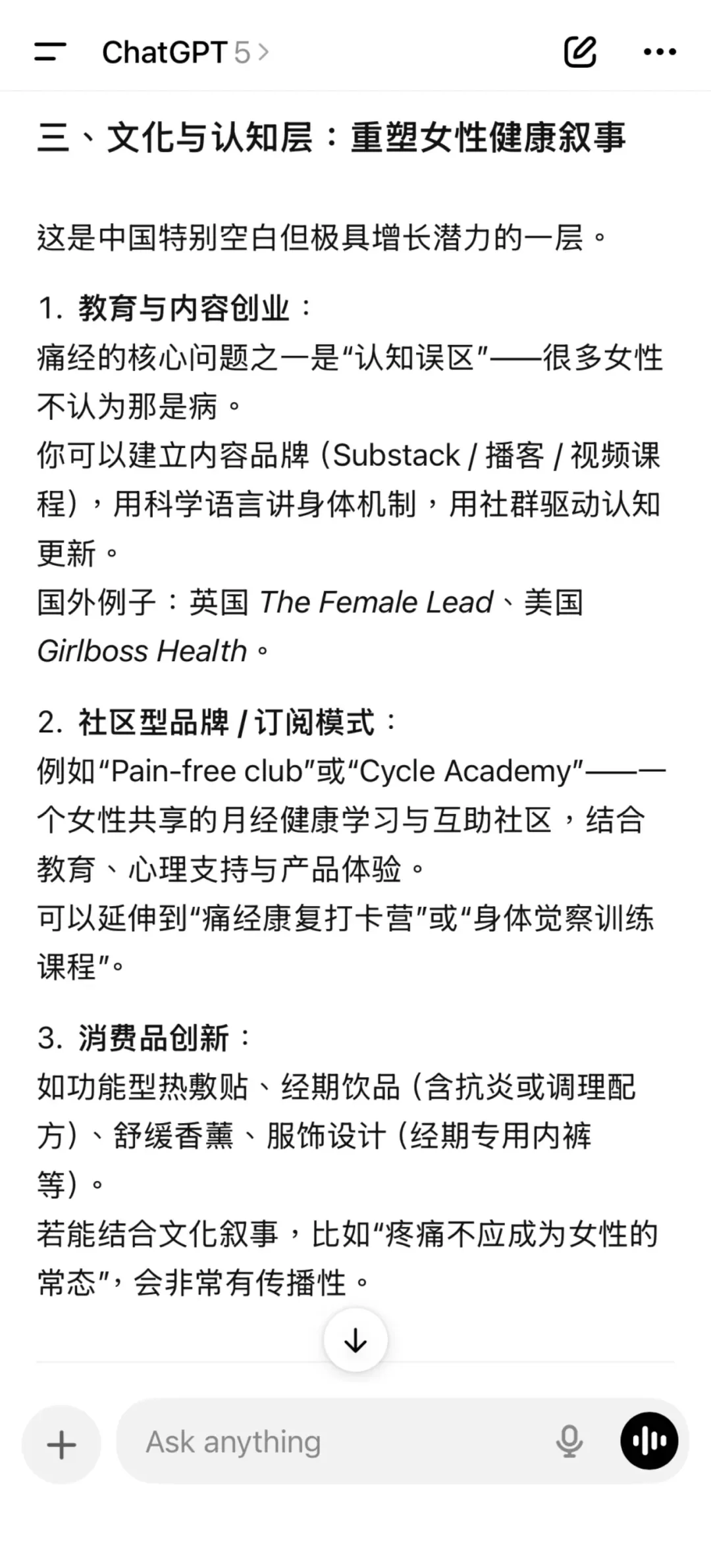
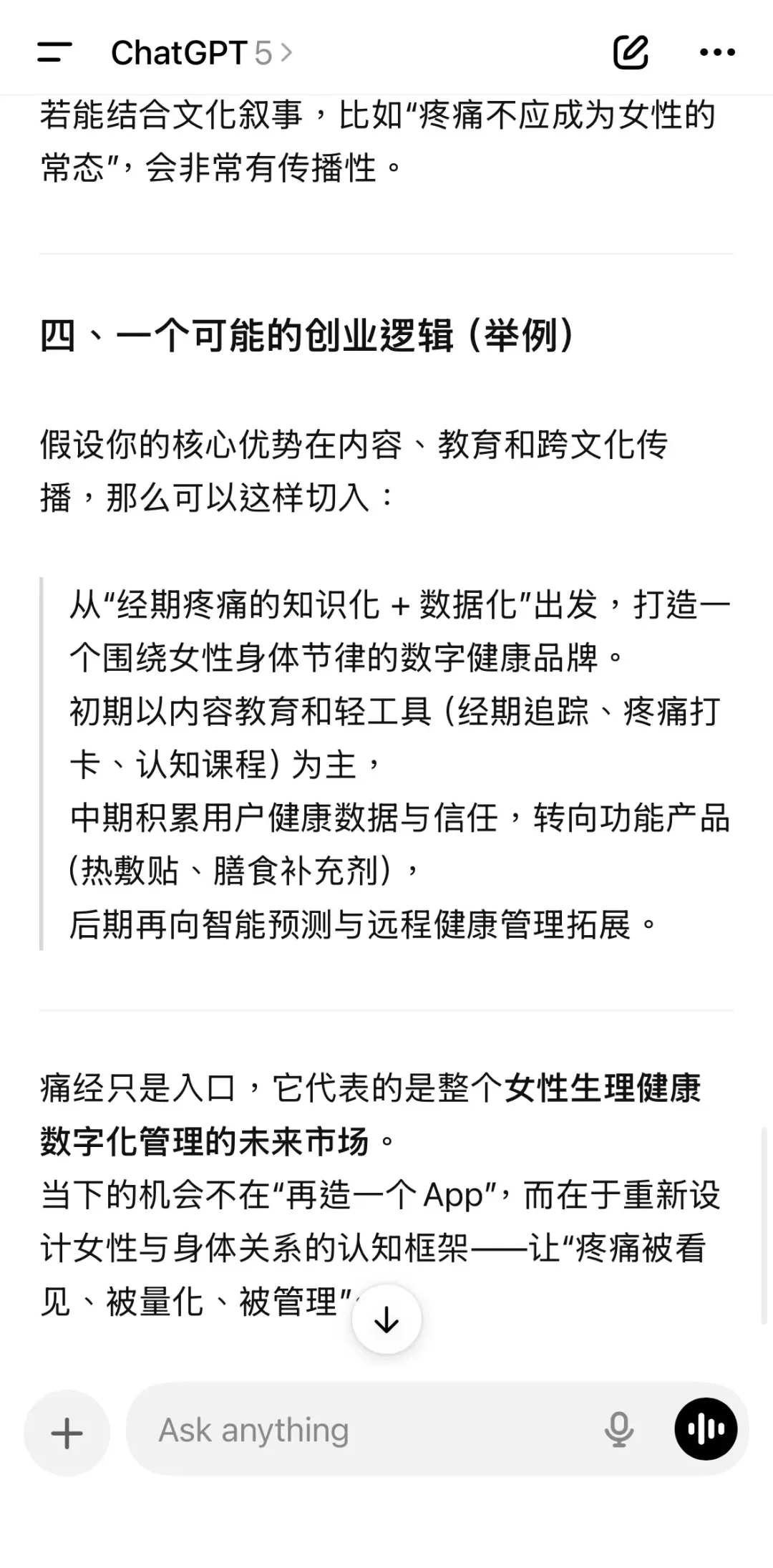
I realized something very clearly: I... I’m not cut out to be the person who leads a huge entrepreneurial venture, but I’m good at gathering information, making complicated things easy to explain, or connecting things that seem unrelated, recording them, and sharing them so more people know about them. It would be even better if I could help people see their value. (If I had enough time, I’d record more!)
So I hope more capable women with ideas—kind and brave women—will join the work of building women’s health!
Of course, men are welcome too, as long as you can improve women’s (or, really, all human beings’) experience of life. But the point is: when it comes to things related to bodily experience, we need many, many more products and information shaped by women’s perspectives!
I’m reminded of a woman I know. Before she gave birth, the women around her never told her about the various kinds of pain she would go through. After experiencing it herself, she said, “Why does nobody talk about this?” She did mention that her female friends around her did help in various ways when she was in pain, but... I felt a strong sense of hindsight after the fact. (I saw a very long post from her late at night; it ended by saying she would delete it when she woke up... I could only quietly like it to say, “I see your pain.” Oh, and speaking of the “like” button, shouldn’t there be a “hug” in situations like this? Or a feature that lets me light up a heart would work too, right?)
Although I also know that once this kind of narrative gets amplified, childbirth becomes even more confusing... So what would actually be the better way to handle it?
Coming back to something like menstrual pain: what we usually know is that lifestyle interventions (heat, regular exercise to improve physical fitness, and so on) can ease pain now or in the future; or that medicines such as ibuprofen can relieve it; and that oral contraceptives can regulate hormones... The last option is rarely mentioned, not only because of the sexual stigma in society and culture—that is, treating contraceptives and sex as the same thing—but also because of the information gap, or information poverty, which makes treatments that are medically established and proven effective almost invisible in public understanding.
Oh, and here we have to mention brown sugar water.
Ladies, please stop drinking brown sugar water during your periods—if you still think that drinking brown sugar water during your period is standard practice, just drink hot water or use a heating pad.
In fact, the reason brown sugar water may help ease pain is the “heat”—it’s not as if you make brown sugar water with cold water, right? And brown sugar is mostly sucrose. As for what sucrose does to the body, you can look it up; different bodies have different levels of tolerance for brown sugar.
So, in short: if you’re cutting sugar, don’t drink it. But if you’re only drinking brown sugar water because you want a sweet drink... fine, go ahead.
Thanks for reading this far. A remote hug! 🫂