Some of you may do a double take when you see this title: Huh? What does that even mean?
Sorry! I was playing with words.
What I actually want to ask is this: after students graduate, beyond knowing where they go next, what else can a school learn from them?
It feels like a question worth exploring, especially for schools that are still relatively young.
As educators, we might tell students to become lifelong learners. Those words pass through the ears of cohort after cohort. Leaving aside, for now, whether educators themselves actually practice what they preach, there seems to be an even more important question that I, or perhaps we, have somehow overlooked. Or more precisely, one that I had never formally named:
Could, or perhaps should, the school that educates and shapes its students also become a lifelong-learning organization?
I once wrote an article called “Humans Can't Escape the ‘Curse’ of Their Environment. Neither Can AI.” where I explored how environments influence, and can even shape, intelligence. My starting point there was harness engineering for AI agents, but the underlying mechanism is remarkably similar to how humans are educated and raised. Think back to when OpenClaw first took off and people kept talking about “raising little lobsters.” That metaphor suddenly starts to make a little more sense.
Recently, I’ve been looking into examples of urban infrastructure and public-space redesign that I had never deliberately paid attention to before, and it has made me feel even more strongly just how much environments matter to people.
A few years ago, when I was still working in education, I was already interested in how school environments could be designed. At the time, I came across a book called “Seeing Change: Participatory School Environment Design.” Oh my god, I was so excited when I found it. I remember thinking: this is exactly the kind of campus I wish a school would explore, and perhaps even grow into.

Later, while visiting another school, I discovered that a playground slide could simply be built on sand.
That detail stayed with me. I think it was partly because it broke my existing assumption about where a slide was “supposed” to be. But more importantly, I later realized that it was also a human-centered and creative practice of participatory school-environment design.
Yesterday, while wondering how public play infrastructure could be designed for extremely hot environments, I suddenly connected that discovery with my experience at a music festival in Seoul. I had actually mentioned both in “How Are We Drawn to a Space?,” but I wrote about them from the perspective of a visitor, or an observer: I am outside this place, looking in.
There is another perspective worth paying attention to, though: I am part of this place. I live inside it.
So I dug a little deeper and discovered that high-pressure air blow guns for dust removal are basically infrastructure-level common in South Korea. Which means a sandy playground plus air guns is actually a pretty perfect combination. Washing the sand off with water would obviously come with all kinds of limitations in a school setting, especially during short breaks between classes.
Coming back to schools, I realized I had actually done quite a few things that were related to shaping an educational environment.
For example, I selectively put some of my own books on the shelves in our office, directly within students’ line of sight. Sometimes, when buying books for myself, one of the things I would consider was: What kind of book might be worth allowing into my students’ world?
The idea was to create a reading pathway that went something like: discover something → become curious → borrow it.
Later, inspired by a senior colleague at another school and their approach to sharing educational resources, I also began building online channels through which educational resources could circulate. I brought tools such as Ketangpai, which at the time were much more common in universities, into middle- and high-school classrooms. I even incorporated elements of podcasting into the curriculum of an elective course.
Looking back, these were all practices connected to educational environment design.
My one regret is that I simply didn’t have enough time.
Many of those practices had barely reached the edge of what they might become before they simply went no further. Even the feedback I collected from students was mixed into the end-of-semester surveys.
And surveys, even anonymous ones, made me wonder: how much information are people really willing to give you there? More importantly, how much of that information can I actually learn from and feed back into the next round of practice?
There was useful feedback. I just expected more.
Thinking about it now, I had this strange feeling back then: my legs could only take one tiny step at a time, while my mind already wanted to start running.
That is probably something worth reflecting on.
Oh! I’ve written this much and still haven’t explained why I wanted to share all of this today.
There was a trigger.
The most direct one is that several former students have reached out to me recently with questions about postgraduate entrance exams, civil-service exams, internships, and employment.
That made me start thinking about feedback mechanisms a school could build in order to learn from its graduates and feed what it learns back into educational practice.
Which brings me right back to the question at the beginning:
After students graduate, beyond knowing where they go next, what else can a school learn from them?
I had an idea for what such a feedback mechanism might look like, so I sent a message to someone I used to work with to share it.
And that message eventually became this very heartfelt piece.
Also, I really did connect a ridiculous number of things together here!
I have to admit, I think I may actually be pretty good at connecting things. As long as I’ve encountered enough information across a wide enough range of areas, and there is a concrete point for all of it to land on, I can often start seeing things that resemble patterns.
I’m also beginning to see more clearly the role I naturally tend to play when supporting other people.
What I enjoy more is providing the scaffolding that helps someone explore and grow. I mean scaffolding both literally and metaphorically. It isn’t meant to prescribe one absolute or standardized path.
Seen from that angle, it suddenly makes sense why I’m so drawn to anything involving the shaping of environments and spaces, including environments for human development.
And I think I’ve finally understood why I care so much about context portability across different AI tools, too!
But, sob, this still isn’t all of me.
These are simply some things that have gradually surfaced as I keep looking back at the traces I’ve left behind and using them to understand myself.
And now that I’ve recognized them, they can continue feeding into whatever I explore and practice next.
So below is the full message I sent to that former colleague. I also want to leave a copy here, because I have this habit of periodically clearing out old conversations, which means anything from a year ago, let alone longer, is basically gone from my WeChat. :)

Hello, Teacher A. Sorry to bother you out of the blue! 🙌
So, one of the students from XX’s first graduating class came to me over the past couple of days to ask about employment. They did quite well in high school and were usually somewhere near the top of the grade.
While we were talking, they mentioned that they had tried reading job descriptions and sending out résumés, and had even gotten one interview. But the interviewer told them that they “didn’t seem to have many hard skills,” and they didn’t get the job.
They felt really defeated afterward. Eventually, they started avoiding almost everything related to employment. Now that the new semester is about to begin and they feel like there’s nowhere left to hide, they’ve finally started facing the issue again.
Something occurred to me while we were talking.
When we used to look at a student’s development, most of our feedback seemed to stop somewhere around the end of high school and the college entrance exam.
But the first cohort has now been out of high school for more than three years and is approaching university graduation. At this point, I imagine all kinds of things are beginning to surface that we simply could not have seen when they first graduated from high school.
For example:
Have they discovered that some of the things they were especially good at back then are still incredibly useful now?
Have they run into situations at university where they suddenly realized they had absolutely no idea how to deal with something?
Are there abilities or experiences that, looking back now, make them think, “I wish I’d encountered this earlier,” perhaps during high school?
Are there things the school did that didn’t feel particularly important to them at the time, but which, three or four years later, they’ve realized have continued to influence them?
I find questions like these, and everything behind them, really interesting.
So I started wondering whether XX could do a very small-scale alumni follow-up project.
Maybe talk to a few representative students from the first cohort: someone who did very well academically, someone whose grades weren’t necessarily the most outstanding but who had very distinctive strengths elsewhere, an art-track student, students who went into different majors, and so on.
Basically, I’m wondering whether we could look specifically for the things we couldn’t see before.
If we could get responses from, say, a dozen or twenty students and then look for recurring patterns, it would essentially give the school a new observational window.
And whatever comes through that window could feed back into future teaching.
It might help the school see which things in the current educational approach deserve to be strengthened further, and which capabilities could perhaps be cultivated earlier through how teaching is designed.
Things along those lines.
(I do feel that our previous career-exploration activities had quite a lot of room for improvement, although that’s based only on my experience with the group I personally led. 🤦♀️)
And even if the school as a whole isn’t interested in doing alumni follow-ups, the arts, sports, and technology departments could potentially do something on their own. Maybe the findings could feed back into future technology education, art education, and so on.
I also had the feeling that you, specifically, might be interested in something like this, which is why you were the first person I thought of sharing it with.
But I have no idea whether the current XX would value this kind of feedback mechanism, or whether the school has already considered or even done something similar.
So this is simply an observation I wanted to share, sparked by a former student reaching out to me and making me think: this feels both necessary and worth doing.
P.S. I suddenly remembered that universities often collect information about where graduates end up working.
If a similar mechanism were brought into primary and secondary education, perhaps we could borrow from that model and make it more comprehensive.
We could care not only about where they went, but also about what they still needed once they got there.
And some of those things they needed might be things that we, the people who once accompanied them through school, could have woven into the educational environment earlier through design, exposure, and guidance.
I really think we need more educational practices like this.

Okay. Back to that earlier question:
Could, or perhaps should, the school that educates and shapes its students also become a lifelong-learning organization?
A school is made up of people, but also of facilities, equipment, and physical infrastructure.
And whether we’re talking about people or objects, all of them are part of an environment, a space—a field that determines how the people living within it influence and even shape one another.
Facilities and equipment cannot decide for themselves how they will exist.
Which means that we, as people, are the greatest variable within it—or rather, the part that can change.
That’s all for now~
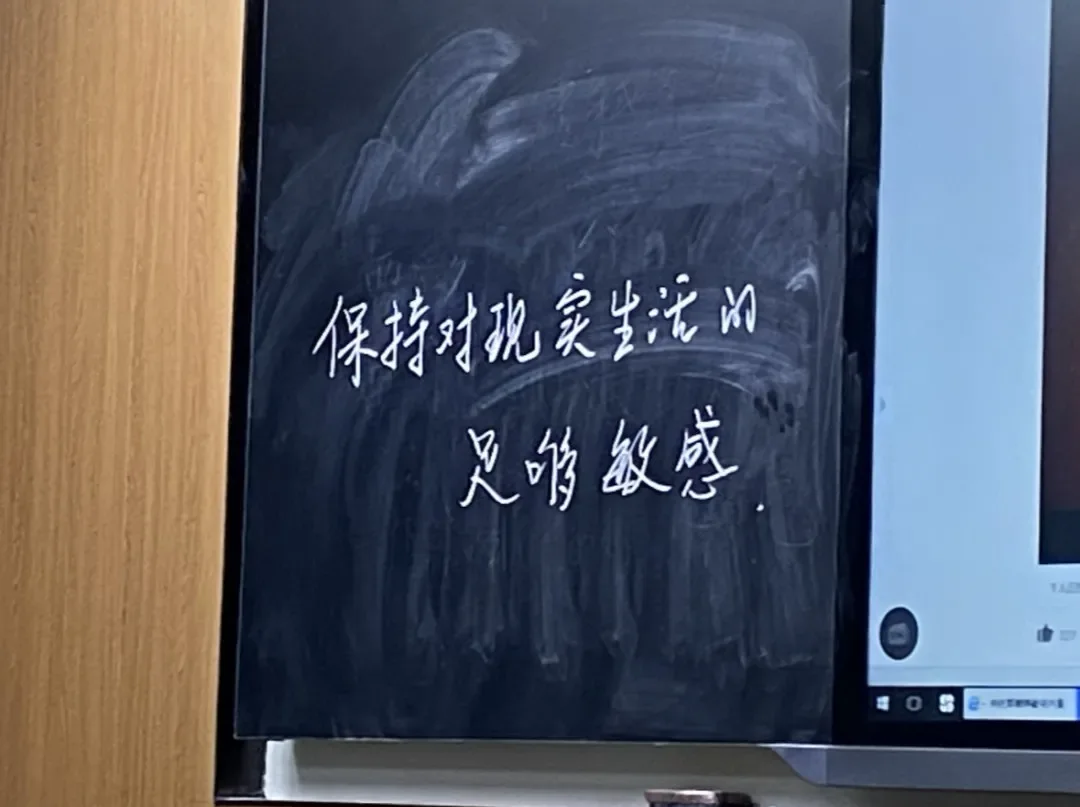
P.S. This image is a sentence someone I once worked with had written on the blackboard: “Stay sufficiently attuned to real life.” I happened to notice it while passing by their classroom, loved it, and took a photo. At the time, I remember wishing I hadn’t missed that class. I also found myself wondering, almost from a student’s perspective: What had the teacher said before writing those words? What were they thinking? What did they hope their students would take away from them? I don’t know why my attention always seems to latch onto things that are a little less grounded in reality… But maybe being a little ungrounded isn’t necessarily such a bad thing after all. 🧐