Reading this long post Andrew Chen shared on X gave me a jolt—especially, as the title suggests, the examples of how to make “results” visible.
Of course, I’m saying this from the perspective of an outsider.
I tried to understand it through my own experience (I can’t promise my thinking lines up with his, but I hope there are some transferable ideas). For example, if I wanted to apply to collaborate on a project, what could I do to maximize my chances of winning the opportunity to work with them—especially if I didn’t yet have much experience in that project’s field?
You need something to show.
This work doesn’t have to be perfect, and it doesn’t necessarily have to have been validated in the project’s industry. What I’m showing here is my possibility, and how seriously and responsibly I would approach the project: I want to work with you for more than what’s written on a résumé, and not just because I say so. I’m trying, I’m putting in the work, and I still have room to grow.
Put simply, show the other person as much of your “malleability” as possible. Whether they want to work with an experienced veteran or a promising newcomer... isn’t something the applicant can control. (Of course, if it’s an open hiring process, you should still read the JD carefully before taking action, hhh.)
The final result may not be what you hoped for, but the process will definitely bring you something else.
It reminded me of a point I might call a “spark.”
When we’re doing content marketing, how can we quietly increase user participation while also expanding our reach?
“Invite” users to share their own stories.
For example, create a tag that isn’t directly related to the product, but lets users share the stories, experiences, or feelings that come up while using it.
This kind of little tip may be second nature to people in marketing and operations, but for me, it was a “seeing again” of something I thought I already knew.
It gave me that feeling of slapping my thighs and making my eyes light up: “Oh, so that’s how it is,” “Wow, it really is like that,” “Ah, that’s interesting.”


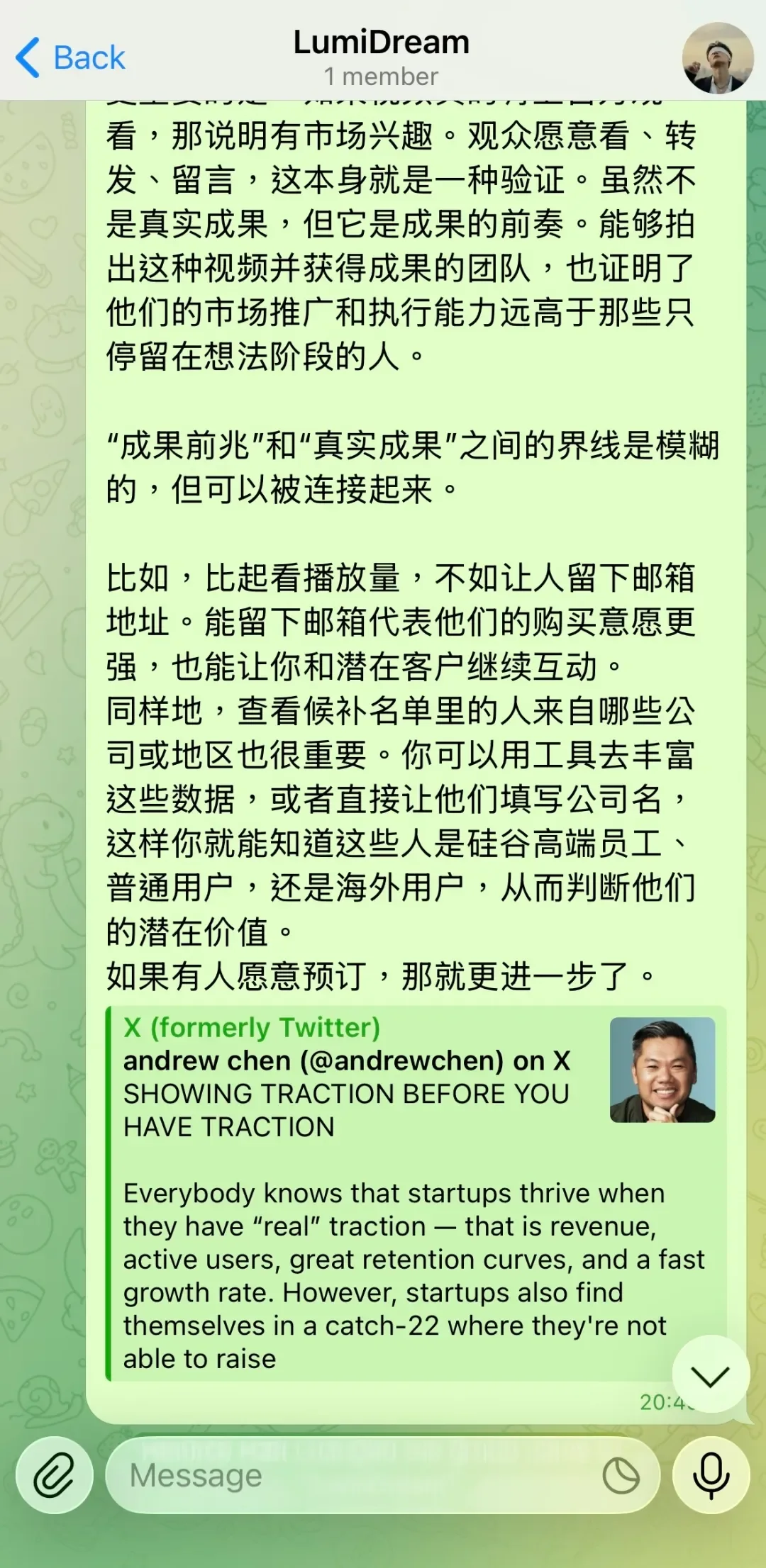
P.S. The original text is below:
Title: SHOWING TRACTION BEFORE YOU HAVE TRACTION
Everybody knows that startups thrive when they have “real” traction — that is revenue, active users, great retention curves, and a fast growth rate. However, startups also find themselves in a catch-22 where they're not able to raise money to get real traction and thus struggle to get there in the real place. So what choice do new founders have to show traction before they have "real traction"?
The answer to this explains the move towards cinematic launch trailers, B2B-oriented accelerators, waitlists, preorders, startup parties, building in public, and many of the other go-to-market trends that have emerged over the last few years. These are all tactics that are low-volume, hard to scale, but relatively deterministic, making them attractive to new startups that want to show precursors to real traction. These precursors end up being metrics like video views or number of waitlist sign-ups. Or SF tpot buzz. Or pipeline logos.
Are these things as good as revenue? No. However, are they better than nothing? Yes.
Let's take cinematic launch videos as an example. These have become very popular over the last year because of their high novelty value. The fact that social media feeds lend more real estate towards video, the fact that they are cheap to create but not too cheap, and as a result they have a tendency to go viral and rack up millions of views for a new product. Depending on how professionally you want it to be done, it can cost as much as $50,000 for a few minutes of spot. Or, if you do cobble it together with interns and shooting and editing yourself, it might be much less than that. It might take a few weeks to script, properly plan, shoot the video, and then organize the social media push to make the video go viral.
For hardware/deeptech companies, the existence of this tactic is a godsend. It might take them more than a year from inception to get the first version of a prototype out. And scale production may take them even longer. To show real traction, that is, revenue growth and retention, is going to take ages. Way too long to get investors and employees excited about joining the company. Although creating a cinematic launch trailer costs money and effort, $50,000 is a lot less than waiting over a year to get your units actually manufactured and ready to ship.
You can argue that if your launch trailer actually gets millions of views, you do learn something. You validated that there's some kind of demand. Enough for people to watch the video, be excited, share it, and potentially comment. This isn't real traction, but it is precursor traction that tells you something. And more importantly, the type of team that can execute this tactic, as well as getting the results of millions of views has separated their go-to-market capabilities and execution from the rest of the market of want-to-be entrepreneurs who have these ideas but aren't able to execute anything.
There is a continuum between precursor traction and real traction that's fuzzy, and you can often bridge the two.
For example, rather than video views, isn't it better to drive people towards a landing page where they can put in their emails? Getting their emails shows deeper customer intent, and allows you to stretch your engagement capabilities past the initial viral spike and into a longer back-and-forth with a potential customer.
Similarly, it's often very helpful to look at the companies and organizations for people who've signed up to your waitlist. You can use lead enrichment products to help you do this or you can explicitly ask for company name. This lets you assess the value of the waitlist so that you can understand are these high-end, Silicon Valley employees or are they broader or are they international users that might be high value or low value. That's yet another way to qualify them for. Pre-orders are obviously even better.