读到 Andrew Chen 在 x 上发布的这篇长文,有被电到——如标题所言,特别是其中提到的如何把「成果」可视化的举例。
当然,这是从一个门外汉的视角来说。
尝试用我自己的经历去理解(不保证思路趋于一致,但希望有可迁移的点),比如说,当我想申请合作某个项目时,我如何做才能最大限度去争取拿到和对方的合作权,尤其是我在该合作项目上的经验还不足的情况下?
得有作品。
这个作品不一定是完美的,也不一定得是在项目所在行业基础上被验证过的——这里,我给出的是我的「可能性」,我对项目的认真、负责态度:我之所以想和您合作,不仅仅是一纸简历,也不是空口说说而已。我在尝试也在努力,并且我还有可发展空间。
说白了,就是尽可能地把「可塑性」展现给对方看,那么对方究竟想要合作的是一个经验老手还是潜力股…这些不在申请者的考虑范围内了。(当然,如果是公开招聘类型,JD 还是得认真看看再行动的 hhh
也许最后的结果不尽如人愿,但这个过程一定会给自己带来别的收获。
我想起一个可以称之为「spark」的点。
在做内容营销的时候,我们如何在不知不觉间提高用户的参与度,顺便扩大影响力?
「邀请」用户分享自己的故事。
比如,建立一个「和产品不直接相关」的 tag,但这个 tag 可以让用户分享他们在使用这个产品的过程中发生的故事/经历/体验之类。
这样的小 tip 在营销/运营人眼里可能就是家常便饭,但对于我而言,是对见惯不惯的事物的「再认识」。
有种「哦原来是这样」/「哇居然是这样子」/「啊好有意思」的双腿一拍两眼发光既视感。


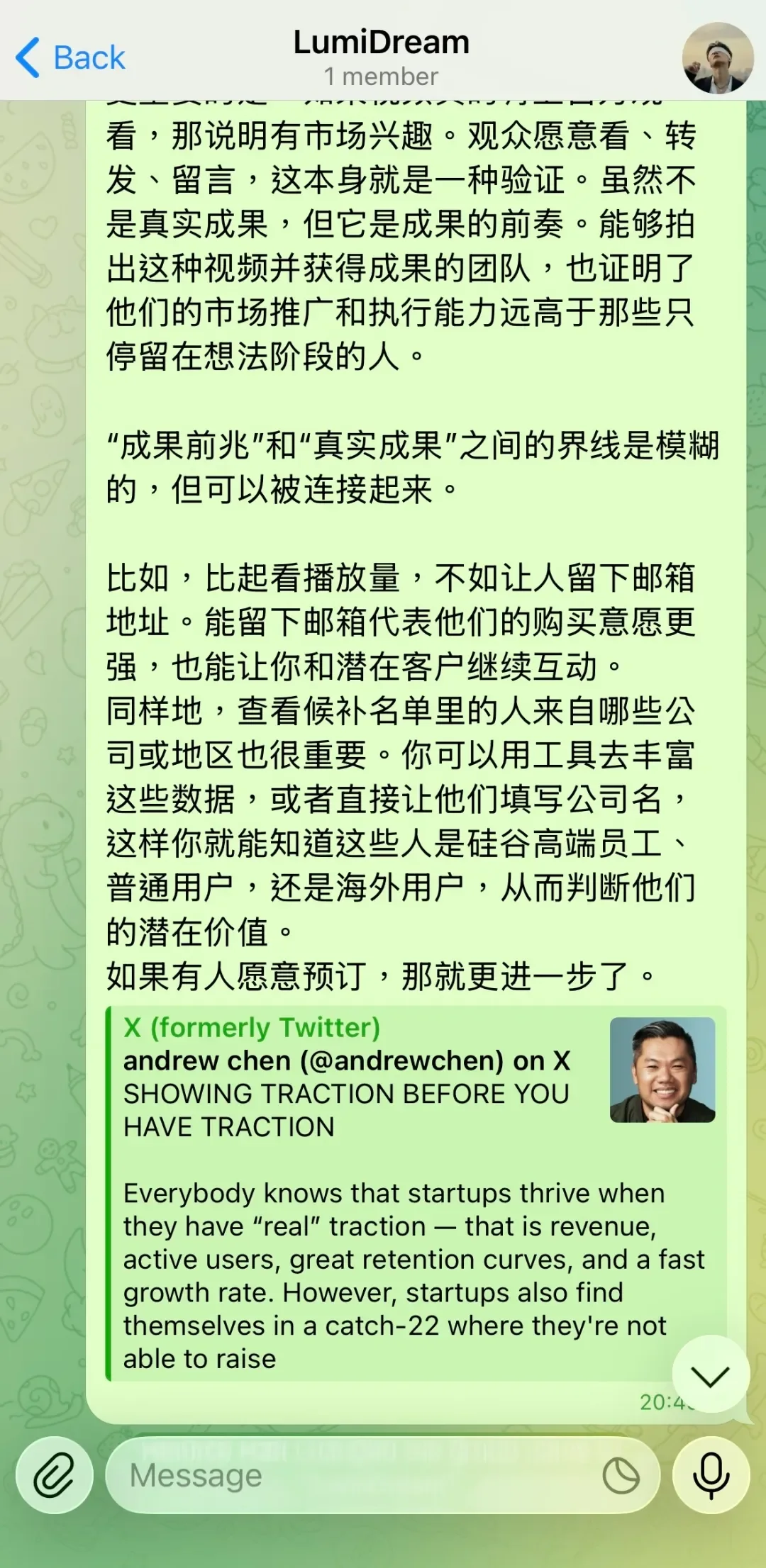
P.S. 原文如下:
Title: SHOWING TRACTION BEFORE YOU HAVE TRACTION
Everybody knows that startups thrive when they have “real” traction — that is revenue, active users, great retention curves, and a fast growth rate. However, startups also find themselves in a catch-22 where they're not able to raise money to get real traction and thus struggle to get there in the real place. So what choice do new founders have to show traction before they have "real traction"?
The answer to this explains the move towards cinematic launch trailers, B2B-oriented accelerators, waitlists, preorders, startup parties, building in public, and many of the other go-to-market trends that have emerged over the last few years. These are all tactics that are low-volume, hard to scale, but relatively deterministic, making them attractive to new startups that want to show precursors to real traction. These precursors end up being metrics like video views or number of waitlist sign-ups. Or SF tpot buzz. Or pipeline logos.
Are these things as good as revenue? No. However, are they better than nothing? Yes.
Let's take cinematic launch videos as an example. These have become very popular over the last year because of their high novelty value. The fact that social media feeds lend more real estate towards video, the fact that they are cheap to create but not too cheap, and as a result they have a tendency to go viral and rack up millions of views for a new product. Depending on how professionally you want it to be done, it can cost as much as $50,000 for a few minutes of spot. Or, if you do cobble it together with interns and shooting and editing yourself, it might be much less than that. It might take a few weeks to script, properly plan, shoot the video, and then organize the social media push to make the video go viral.
For hardware/deeptech companies, the existence of this tactic is a godsend. It might take them more than a year from inception to get the first version of a prototype out. And scale production may take them even longer. To show real traction, that is, revenue growth and retention, is going to take ages. Way too long to get investors and employees excited about joining the company. Although creating a cinematic launch trailer costs money and effort, $50,000 is a lot less than waiting over a year to get your units actually manufactured and ready to ship.
You can argue that if your launch trailer actually gets millions of views, you do learn something. You validated that there's some kind of demand. Enough for people to watch the video, be excited, share it, and potentially comment. This isn't real traction, but it is precursor traction that tells you something. And more importantly, the type of team that can execute this tactic, as well as getting the results of millions of views has separated their go-to-market capabilities and execution from the rest of the market of want-to-be entrepreneurs who have these ideas but aren't able to execute anything.
There is a continuum between precursor traction and real traction that's fuzzy, and you can often bridge the two.
For example, rather than video views, isn't it better to drive people towards a landing page where they can put in their emails? Getting their emails shows deeper customer intent, and allows you to stretch your engagement capabilities past the initial viral spike and into a longer back-and-forth with a potential customer.
Similarly, it's often very helpful to look at the companies and organizations for people who've signed up to your waitlist. You can use lead enrichment products to help you do this or you can explicitly ask for company name. This lets you assess the value of the waitlist so that you can understand are these high-end, Silicon Valley employees or are they broader or are they international users that might be high value or low value. That's yet another way to qualify them for. Pre-orders are obviously even better.