Recently I wrote a long piece and wanted to archive it here too—an extremely subjective perspective that reflects my preferences for using software, the path by which I digest knowledge, and even my own answer to the question: “What does reading mean to us in the AI era?”
Afterward, I also wondered:
1. How did people read before storytellers appeared?
2. How did people read after storytellers appeared?
A comparison might be: how did people read before and after the Dedao app appeared?
There’s a lot wrapped up in this, and I won’t expand on it here. I’ll leave it for later.
00 After Receiving Mike’s Invitation
A few days ago, I received a DM from Mike, the CEO of Perch, inviting me to try Perch and asking for feedback.
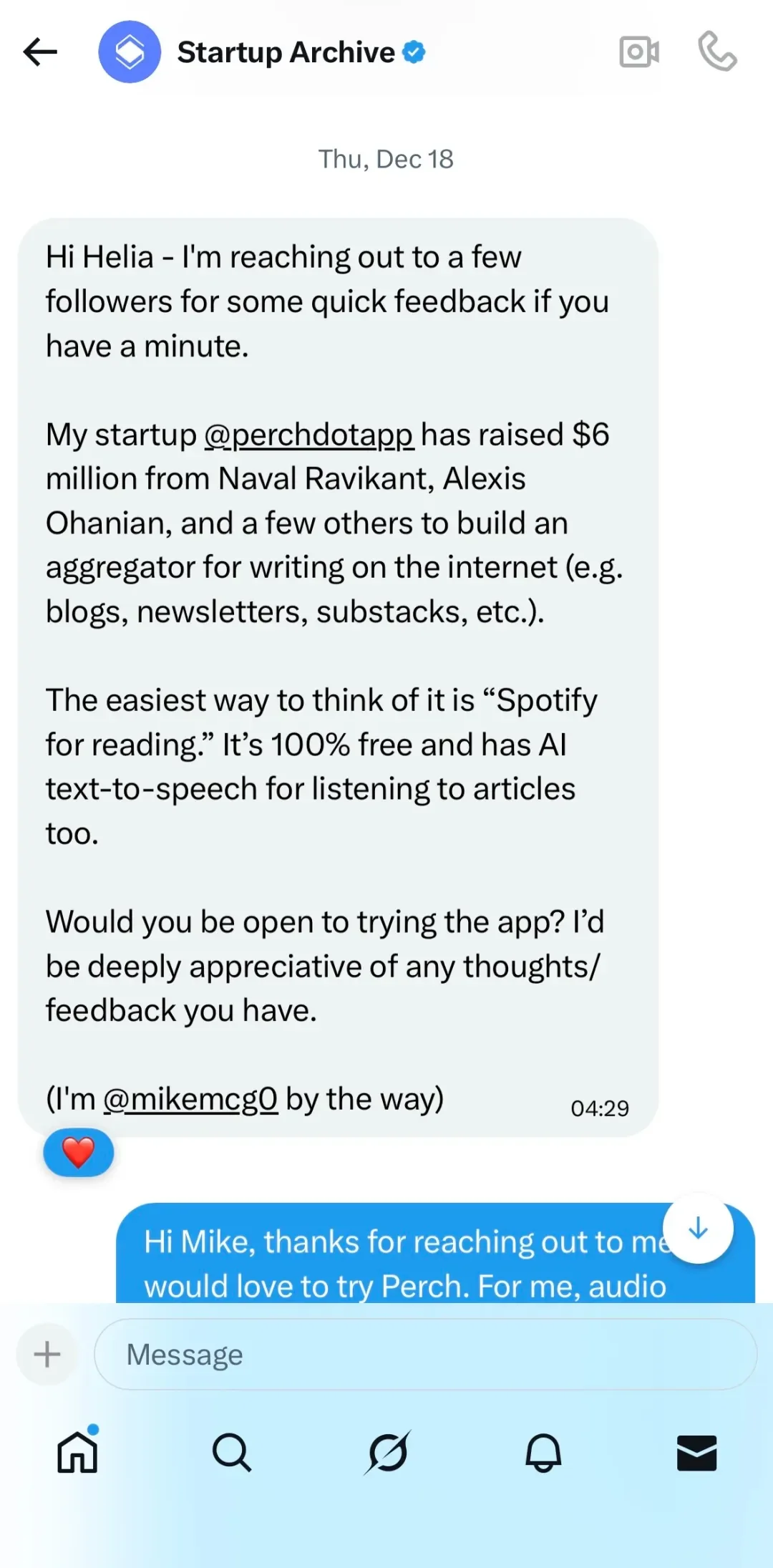
To be honest, I was a little shocked when I saw the message.
A little intimidated too.
Mike runs Startup Archive and Founders’ Tribune. Perch has taken investment from Naval, Alexis Ohanian, and Balaji—$6M... Seeing those names and facts in front of me made me feel that this product really wants to make something bigger.
And the idea of a “Spotify for reading”... pretty tempting, right?
But I didn’t know what kind of feedback I could give. At least in that moment, not much came to mind.
Thinking about it afterward, I do subscribe to newsletters (mostly on Substack), but I barely use RSS. My content-discovery routes are also scattered: X, public accounts, and articles scattered all over the internet. Whenever I find something good, I also have the “save it first, digest it later” impulse.
So I downloaded the app and studied it for a long time.
Then more ideas came to me, along with memories from the past.
First, I want to explain why I’m taking the time to write this note seriously.
While learning about Perch, I looked at Mike’s hiring JD. It included a paragraph:
Here are the assumptions that have to hold for Perch to be a $100 billion company, using Spotify's $125 billion market cap and 640 MAUs as a comp:
1. 640 million MAUs:Hundreds of millions of people already read blogs and newsletters, and we think we can grow the market to 1 billion+ by removing discovery/cost friction from the user experience.
2. $30 ARPU:Spotify's revenue per user is $30. Instagram's is $50.
Finding this made my intuition from earlier click into place.
This is real. They want to do something big!
So if Perch’s goal were simply to make a “pretty good reading app,” user feedback would be easy: say what works, what doesn’t, what features you want... and that would be it.
But it looks like Mike wants to “make reading free,” really benchmark against Spotify and serve a billion users...
Then I couldn’t just toss off a few sentences of feedback.
I had to look back over my past experience of acquiring knowledge, distill my reading needs, and feel the app as a real reader would—I know a fair amount about reading and audio experiences.
Before continuing, I need to state one premise:
The following comes mainly from the perspective of a user who is already used to reading with a clear question in mind and wants to turn information into judgment and action quickly.
This isn’t the default state of every reader, but it does represent some people’s reading needs in the AI era.
01 TTS Quality Is Actually Pretty Good
Perch’s TTS (Text-to-Speech) is pretty good.
The voice is relatively natural, the phrasing is smooth, and the distinction between stressed and unstressed sounds is fairly clear.
However, it occasionally has a small flaw after a pause—something like noise, though not quite noise. Maybe it’s an issue at the boundary of the audio processing? (It happens extremely rarely, so it’s basically negligible. But my ears are a little sensitive, and when I’m focused on listening to audio, I can’t quite ignore it. 😂)
Overall, if I had to rate it for listening, I’d give it a 7.5–8.
But here’s the problem.
It reads the whole thing.
It plays everything linearly, from the title to the ending, without skipping a word.
That reminds me of a painfully awkward scene:
I ask a friend, “What’s this article about?” and she says, “Here, I’ll read it to you from the beginning.”
...That’s not what I need. 😂
What do I need?
I need to grasp the article’s core judgment, actionable insights, and anything I can take away and use, all in a short amount of time.
In other words, I want compressed cognitive density, not the content itself.
Perch does have an AI Takeaways feature.
But I looked at the Takeaways for several articles, and they simply listed the points one by one—around five to ten for each article, sometimes even more.
Each Takeaways item is roughly one or two sentences, in a format like this:
- Hiring the best starts with prioritizing drive over credentials and specific skills...
- Curiosity indicates passion and a love for one's craft...
- Look for proven accomplishments beyond typical resumes...
- …
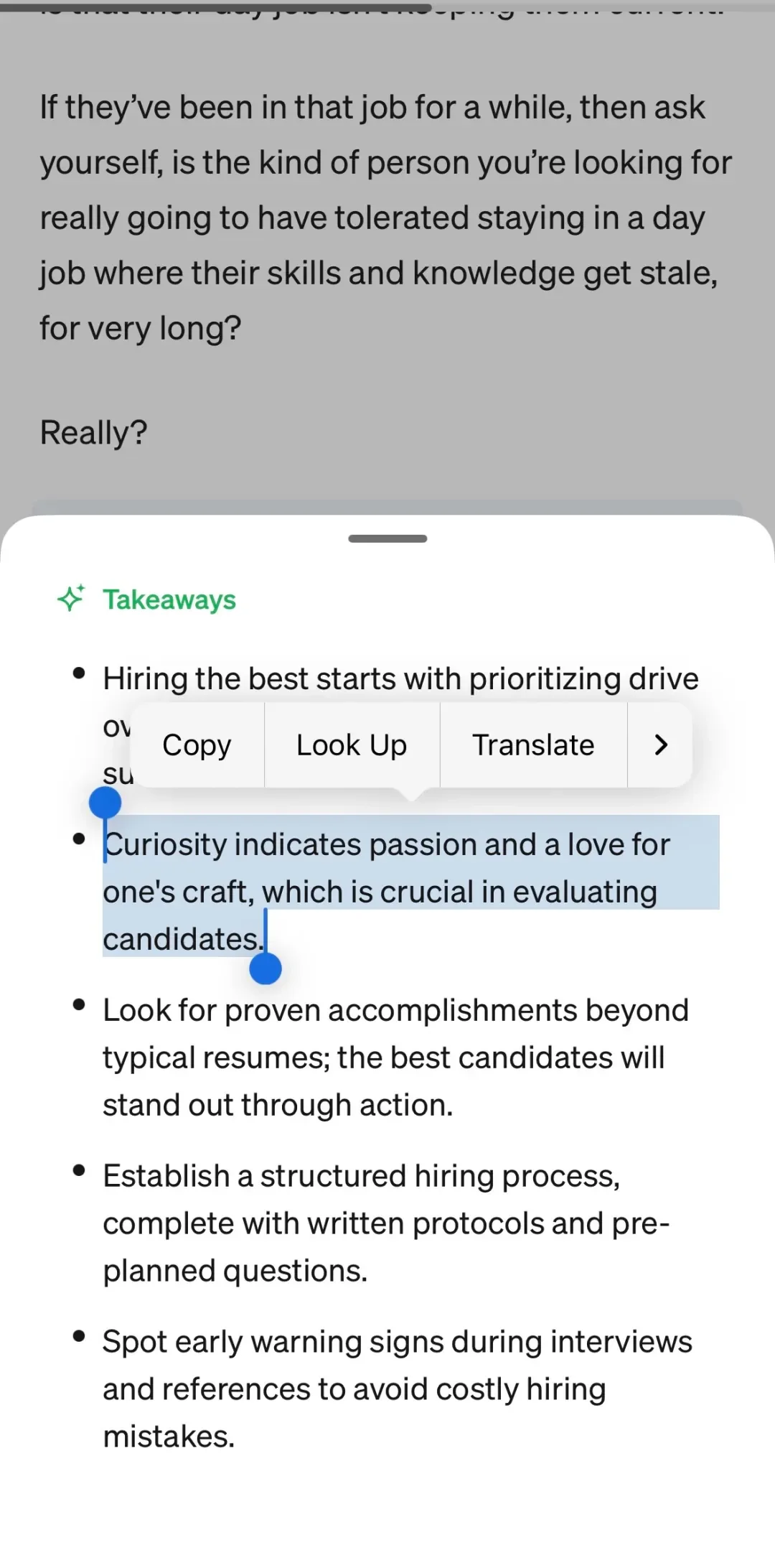
How should I put it... these Takeaways are descriptive; they simply list the article’s main points.
But when readers come to an article with a clear purpose, they need more than descriptive points. They need more actionable insights—or at least a prompt telling me how to use the information.
For example:
- If you’re a PM, which part should you pay attention to?
- If you’re hiring, which recommendation in this article best fits your situation?
- How does this idea conflict with something else you’ve read before?
- …
I even wondered whether Takeaways could be personalized.
Could the app ask me: What’s your role? What do you want to get from this article?
Then, based on my answer, it could generate Takeaways tailored to my needs.
Of course, this means the user would have to provide background information or customize some settings.
But for people who genuinely want to get actionable insights quickly, that bit of friction is worth it.
Coincidentally, Mike wrote this in the Founding Engineer job description:
Full-stack features that remove friction from the reading experience. Some examples include text-to-speech so users can listen to articles on-the-go and AI summaries that save them time.
Maybe you caught the key point too: AI summaries that save them time.
That shows the team understands the value of time.
But for users who already know what they’re looking for, do the current Takeaways really save time?
There is so much good content, and every reader has to spend time filtering what is worth reading. So:
- Is this article worth spending 20 minutes on?
- If I only have five minutes, which part should I read?
- If I’m a PM, founder, or investor, what should I pay attention to?
- …
In the Chinese-speaking world, there’s a school subject called Chinese language arts.
When we were young and did reading-comprehension exercises, teachers didn’t just ask us to summarize the central idea. They also asked us to understand what the author was implying—the things that weren’t written directly, which are what take you beyond the text into insight and decision-making.
Today’s Takeaways stop at the level of summarizing the central idea.
So I think that saving time isn’t only about compressing content. It also means filtering (which Perch already does, though perhaps it could become more segmented and specific) and making decisions.
In one sentence, my understanding of “Spotify for reading” is this: I need Insight-to-Ear, not just Text-to-Speech.
Music can be consumed linearly because music gives us emotional value.
Reading may give us more judgment and the ability to act. Of course, it also offers companionship, but probably in a smaller proportion. Reading always carries cognitive load—unless it’s the kind of feel-good web fiction known in Chinese as 爽文.
So if Perch wants to become “Spotify for reading,” I think it needs to understand the core question of how to compress cognition, and then adjust content playback around that core.
There’s also a small friction point I’ve been complaining about with Gemini: some content can’t be copied across line breaks.
Knowledge needs to flow. We always need to send something out of the app, and if I want to use Takeaways as content to share externally but can’t copy across line breaks, it’s incredibly frustrating. (Phones should really learn from the web’s ability to copy across unlimited line breaks. 😂)
02 I Can’t Import External Content
Suppose I find a valuable article on a browser page and want to import it into Perch to listen to.
But Perch doesn’t appear among the app icons in the share sheet (the iPhone’s native Share Extension).
I see a great long-form post on X and want to put it into Perch for a deeper reading.
There’s no way in there either.
Even as an international user, I can’t bring the good articles I find on Xiaohongshu or public accounts into Perch.
So, at the moment, Perch is actually a relatively closed ecosystem. It only accepts RSS and newsletters, and only lets users read content inside the app.
That made me think of two concepts: edge vs. center.
Perch is where the center is, while the content users like me discover sometimes comes from the edge.
In other words, the places where I find good things worth reading aren’t limited to a dedicated reading app.
But Perch is telling me: I don’t accept this content.
I understand that Perch doesn’t want to be an information-collection platform; its ultimate goal is to become Spotify for reading.
But I actually think that as long as the app itself is good enough (what counts as “good enough”? I need to think about that too), it can’t become a collection platform.
Why?
Because even people with strong cognitive abilities—or a strong desire to absorb knowledge—have more or less inertia when it comes to taking action.
And if an app can reduce the friction of acquiring knowledge—for example, I paste in a link and it immediately generates actionable Takeaways, or Takeaways that meet my personal needs, and lets me listen right away—then I won’t just “save” things. I’ll actually use what Perch gives me.
Some people might think that sounds too utilitarian.
To be honest, I thought the same way in college.
But now I think that when you’re serving a user with a clear cognitive goal, being as utilitarian as possible is actually a good thing.
Because:
- The basic functions remain for people who want to use them.
- People who want to use the leverage an app provides to quickly fill gaps in their understanding can genuinely benefit too.
Almost every app now pursues less friction (for example, ChatGPT recently moved Live mode from an interface to a Chat Box, which delighted me), so why not do the same for acquiring knowledge?
Spotify aggregates the work of almost every musician, making it easier for users to discover or find the artists and styles they like.
Likewise, if Perch can make reading less friction-filled, that is what would truly make “reading happen.”
I suddenly thought of Are.na and Sublime.
I really like these two products. Aesthetically, they do better than most collection platforms: simple, restrained, and sophisticated.
But to me, they’re still just “good-looking collection apps.”
I know they have their own product theses—Are.na emphasizes associative thinking, while Sublime emphasizes an inspiration engine—but the problem is that the friction of acquiring knowledge is still too high for me.
I have to organize things manually, build connections manually, and review them manually...
The result is that I save a lot of things but rarely truly “digest” them.
The existence of these products is perfectly reasonable, but aesthetics alone aren’t enough. They also need to spend energy on reducing friction.
Pocket’s shutdown made me sigh, even though I never used it. But a read-it-later feature sounds so pointless—wouldn’t that just be a feature for people with a collecting habit? 😂
Speaking of information collection, I have to admit that I’m a serious hoarder of sources myself.
Early on, I used goto-mars to save web pages and articles, and I’ve also always used Google’s bookmark folders, organized by topic and situation:
Podcasts vs. audio processing (specific technical contexts).
German vs. German A2 exam preparation (specific grammar and use cases).
Education vs. teaching Chinese (materials needed for a particular class).
And so on.
But over time, I noticed:
goto-mars stayed in my memory only because it kept following me through my Google account and sat on my home screen.
The things in my bookmark folders that I take out and use repeatedly are only the ones directly related to my life or work (especially tools).
The rest?
They just keep lying there in the folders.
If we compare this to written content:
To occupy a user’s mind for the long term and make them stay, it’s important not only to make the user feel that the knowledge is being used by them (a kind of spiritual satisfaction)—
Having a strong connection with the user is also an important consideration.
In other words, knowledge has to follow them into their physical world in some visible or invisible way—to “live in their life.”
That may be what real retention is.
03 A Potentially Overlooked User Group
I also noticed that Perch’s product design has some very obvious cultural assumptions.
It assumes that users:
- Are used to subscribing to newsletters
- Understand what RSS is
- Consume content through a linear “subscribe–receive–read” process
That makes sense for users in the US and Europe.
But in many non-English markets, such as China, this logic doesn’t really hold.
China’s content ecosystem is platform-native—public accounts, Xiaohongshu, Jike, Douban, Zhihu...
Every platform is a closed content universe. There is no RSS, and RSS isn’t needed. (If there is something similar, following public accounts on WeChat is a little like subscribing to Publications on Substack. The difference is that Substack is a pure content platform, while WeChat is a super app.)
People almost always “run into” content in their feeds instead of actively subscribing to it.
Of course, I know very clearly that Perch’s current target audience is English-speaking users, and it hasn’t considered globalization yet.
And if it really did globalize, data compliance in a market like China would be complicated. It may not be something Perch wants to touch in the short term.
But what I’m saying is this:
If Perch supported importing external links and text, the beneficiaries wouldn’t only be Chinese users who aren’t used to the RSS/newsletter subscription model.
Any reader who discovers good content “outside the RSS/newsletter universe of Perch” would need this feature.
Also, Spotify actually allows podcasts to be imported through RSS.
Podcast creators can use third-party hosting platforms such as Buzzsprout or Firstory and then distribute their shows to Spotify through RSS. Spotify handles distribution, playback, and recommendations. It doesn’t reject them just because the content didn’t originate on Spotify (though it’s true that it accepts content selectively).
So why can’t reading work the same way?
Rather than “educating users to adapt to RSS/newsletters,” the more reasonable thing to do would be to “adapt to users’ real behavior” (how users relate to reading is connected to cultural background).
I don’t want Perch to become a garbage dump where you can throw anything.
But it could let me:
- Paste a link and let AI extract and summarize it
- Or import it quickly through a Share Extension
- Then use Perch’s capabilities—AI Takeaways, TTS, and so on—to digest the content
- …
In that case, Perch would be more than a content endpoint. It would be a layer where cognition happens.
It would move from “I can only read what already exists in Perch” to “I can bring the good things I discover outside into Perch and absorb them.”
Mike himself runs Startup Archive and Founders’ Tribune, two content products with hundreds of thousands of followers on Instagram and X.
In the hiring JD, he calls them a “powerful owned-media asset” that can be used to:
1. Improve the quality of Perch’s content
2. Lower customer-acquisition costs by directing traffic from Startup Archive’s social accounts to Perch
3. Ultimately generate revenue
Mike understands very clearly that “where the content is, that’s where the users are,” and he knows how to bring users to Perch through X and Instagram.
So why does Perch instead lock users inside the RSS/newsletter universe?
If Mike can direct traffic to Perch through social media, why not let users import content into their own Perch libraries through social media?
Oh, I have another idea too, inspired by a little tool I designed recently. My original intention was to serve podcast creators by helping them generate visual content such as posters and quote cards to share externally. So far, though, I’ve only made an MVP like voice-to-paint.
So if Perch let users turn highlights and Takeaways into shareable posters or quote cards with one click, users wouldn’t just be “consuming” content; they could also “spread” it.
For Perch, this would be zero-cost user acquisition: “good content + easy sharing = organic growth.”
04 What Does Perch Actually Want to Become?
Setting Mike’s vision aside, I’ve been wondering what Perch actually wants to become.
After exploring the app, I have a feeling:
Right now, Perch is more like a player in the world of reading. It mainly solves the problem of “how to listen to articles,” a little like the Chinese version of WeChat Listening to Books, which focuses only on listening to books.
Of course, I also understand that not every reader knows what they want at the beginning.
For these users, AI Takeaways may first serve to “give them an outline” and “lower the barrier to entry.”
But once users gradually develop their own questions, whether the tool can keep evolving into an accelerator for judgment and decision-making will determine whether it can retain people over the long term.
What I need more is a thinking partner to help me “become smarter faster,” moving from spiritual satisfaction to greater willingness to act and then to feedback from the physical world.
AI today puts leverage in front of human beings, but only a small number of people truly benefit. I first started following Karpathy because of the “Karpathy effect.” I also hope to make deep and complicated knowledge easier to understand and enter, so it won’t remain locked away and can “make its way into ordinary people’s homes.”
Perch does a decent job with listening and reading. Its interface is clean and attractive, and its “playlist for reading” feature is creative.
But if Perch’s ambition is to become the Spotify of reading—“make reading free”—then it can’t be satisfied with being only a good player.
Spotify’s music isn’t free, but it makes music more accessible.
YouTube’s videos aren’t free either, but it makes video more discoverable.
What about Perch?
If it only makes “content that is already free” easier to listen to, what is its value proposition?
I previously imagined the future of apps and systems. Although this future was an idea I brainstormed with AI, I think it offers useful reference points.
I think Perch could perhaps become:
A cognitive operating system that aggregates not only text content, but also judgment and decision-making.
This matches my need to collect podcast information. Having an RSS distribution platform—a dedicated podcast-listening app—isn’t enough. I also want another tool that can help me quickly find the podcast information and content I need.
Imagine if I could ask Perch:
- Which articles have recently discussed the business models of AI agents?
- Give me a five-minute audio summary of the core ideas in those articles.
- If I’m a PM, what should I pay attention to?
- …
Brain-computer interfaces are something humans have been trying to build for a long time. If they really become possible, what will the future look like?
I think thinking about that question will affect product decisions—if what we’re pursuing is long-term value rather than immediate profit.
05 Some Specific Suggestions
So, to sum up, here are a few very specific product suggestions:
1) AI Takeaways:
- Don’t just list what the article says; also tell the user things like, “If you’re X, you should pay attention to Y” (I think designing the prompt for this would be interesting too)...
- Offer different listening modes, such as “five-minute highlights” vs. “all takeaways” vs. “full article read aloud”...
- Consider personalization: let users set their role and context, then generate customized Takeaways...
2) Content Import:
- Consider adding a Share Extension
- Let users paste a link and have AI automatically extract and summarize it
- If you’re worried about becoming a collection platform: A. limit the number of imports free users can make each week, or B. allow only premium users to import without limits
- Design a visual sharing feature that lets users attract users
3) Audio Experience:
- Offer the option to listen to highlights first and then decide whether to listen to the full article
- Add timestamps so users can jump to the parts they’re interested in
- Consider making “highlight audio” that reads only the passages highlighted most often. But this might require collecting users’ highlight records, so whether it involves privacy concerns would need careful consideration.
4) For You Feature:
- Don’t only recommend articles that are “similar”; also recommend articles that might “challenge” the user
I personally want this kind of recommendation design.
There’s a Chinese idiom, “sitting in a well and looking at the sky”: a frog sits at the bottom of a well and thinks the sky it sees when it looks up is the whole universe.
I think the “curse of knowledge,” or the “information bubble,” needs to be broken. But technology today is reinforcing the phenomenon instead.
06 Why Did I Dare to Write All This?
To be honest, I feel pretty uneasy writing this far.
Mike sent me a DM, and I responded by writing this huge piece... It looks as if the whole thing is “criticism”... 😂
In the culture I grew up in, this is a pretty bold thing to do. But... how should I put it? It reminded me of a scene.
During my first career, I met a wonderful senior colleague. We only worked together for half a semester (I was working at a private school at the time), and then he left because the workplace culture didn’t suit him.
At one meeting, we were discussing a decision related to the students. I’m the kind of teacher who is very protective of students and can’t stand seeing them restricted, so I got into a conflict with him. I made him so angry that he jumped up from his seat and went back to his vice-principal’s desk.
Even though it has been three full years since I first resigned, I still remember this vividly. I’ve always felt that he gave me enough “permission” without saying so, and that was why I dared to challenge him. With another leader, I probably wouldn’t have dared.
Still, his intention was to do what was best for the students. He wanted them to be more self-motivated and self-disciplined in their studies, while I believe children are born with a nature that wants to play and shouldn’t be tied down too tightly. So even though he was already at the age when someone would normally be retired and rehired, I still saw him as a wonderful friend across generations—someone almost old enough to be my grandfather. 😂
Coming back to why I still dared to write this, being invited essentially gave me the corresponding right to speak freely. Besides, I’m a nobody on Substack and X; I can’t make much of a wave... So I might as well write boldly.
Reading really is scattered and spread everywhere, just as Mike said.
Newsletter overload, the frustration of paywalls, discovery fatigue... these problems are real too. I’m a typical user who faces all of them myself.
And as a product seriously trying to solve these problems, I hope Perch can become better.
I don’t know how much this article will help Perch. But after finishing it, I realized that I wasn’t only giving Perch feedback; I was also thinking about what “reading” means in the AI era.
A sentence popped into my head: “Reading is more than reading itself.”
I think that if Perch can understand this, it will become a very special product.
I’ll keep following it in the future.
I also hope Mike and the team can realize the vision of “Spotify for reading” and build a better Perch.
P.S. A truly mature reading tool can’t require everyone to be an efficient reader from the start. It should allow—and even help—people at different stages to gradually gain more control over knowledge within the same system. So everything above represents only me. Thank you for reading.