Over the past couple of days, using whatever scraps of time I had, I gave my blog a major redesign from 0 to 1. It finally went from an old-school 2010 blog layout (though this wasn’t even the original version):
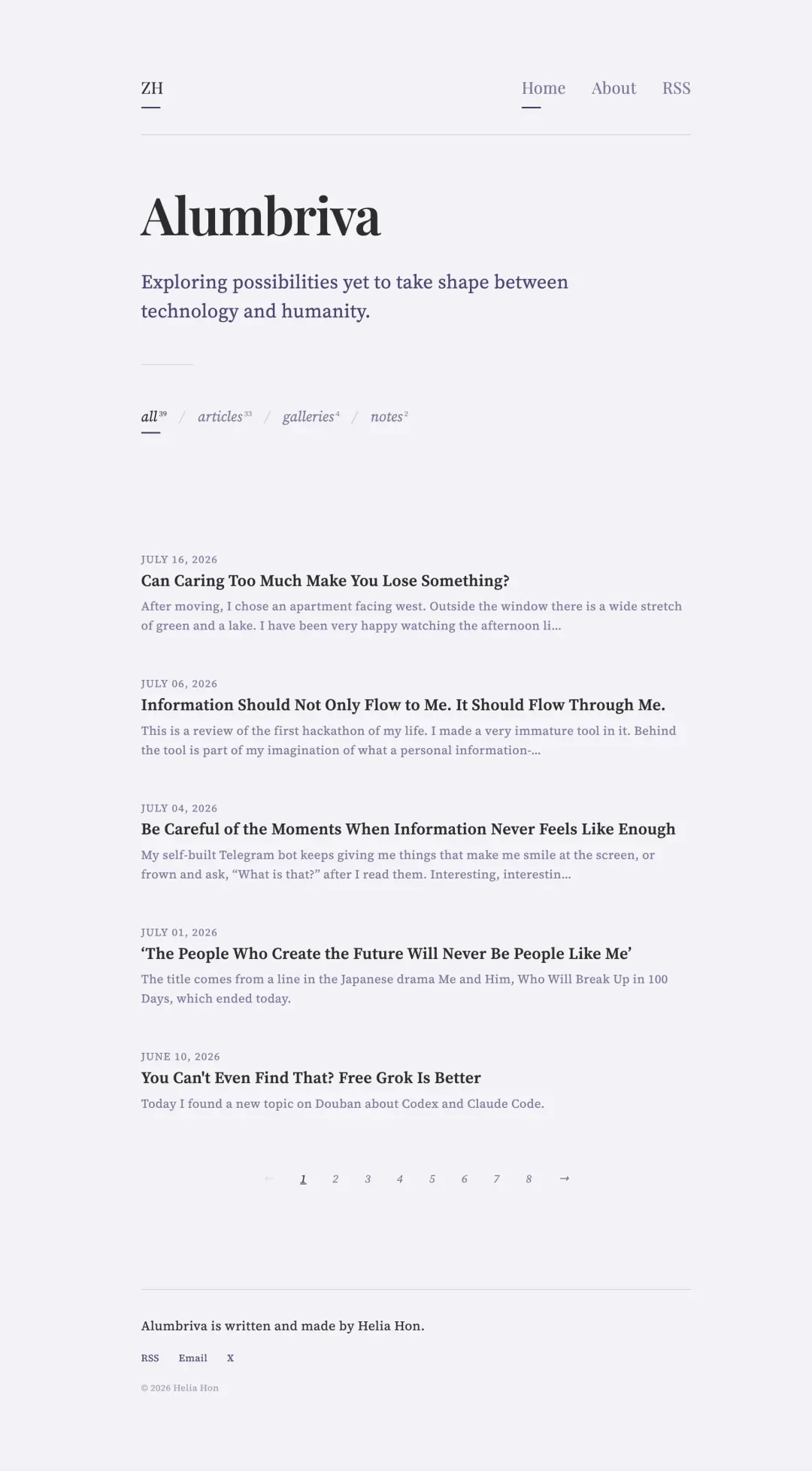
I combined colors I like, such as misty purple and grayish purple, with elements like astronauts, stars, the sun, and the sea, and turned it into what you see now (note: the second and third images below each have a small detail):
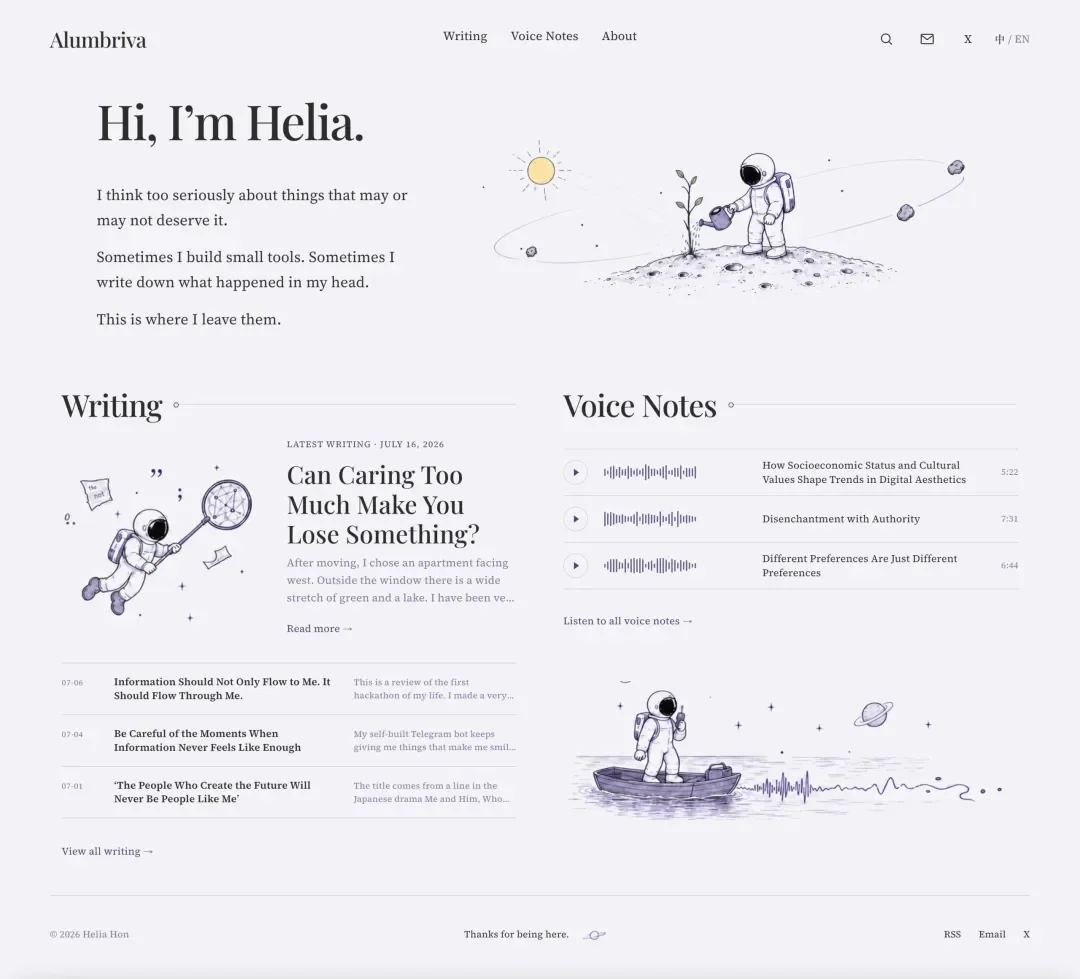
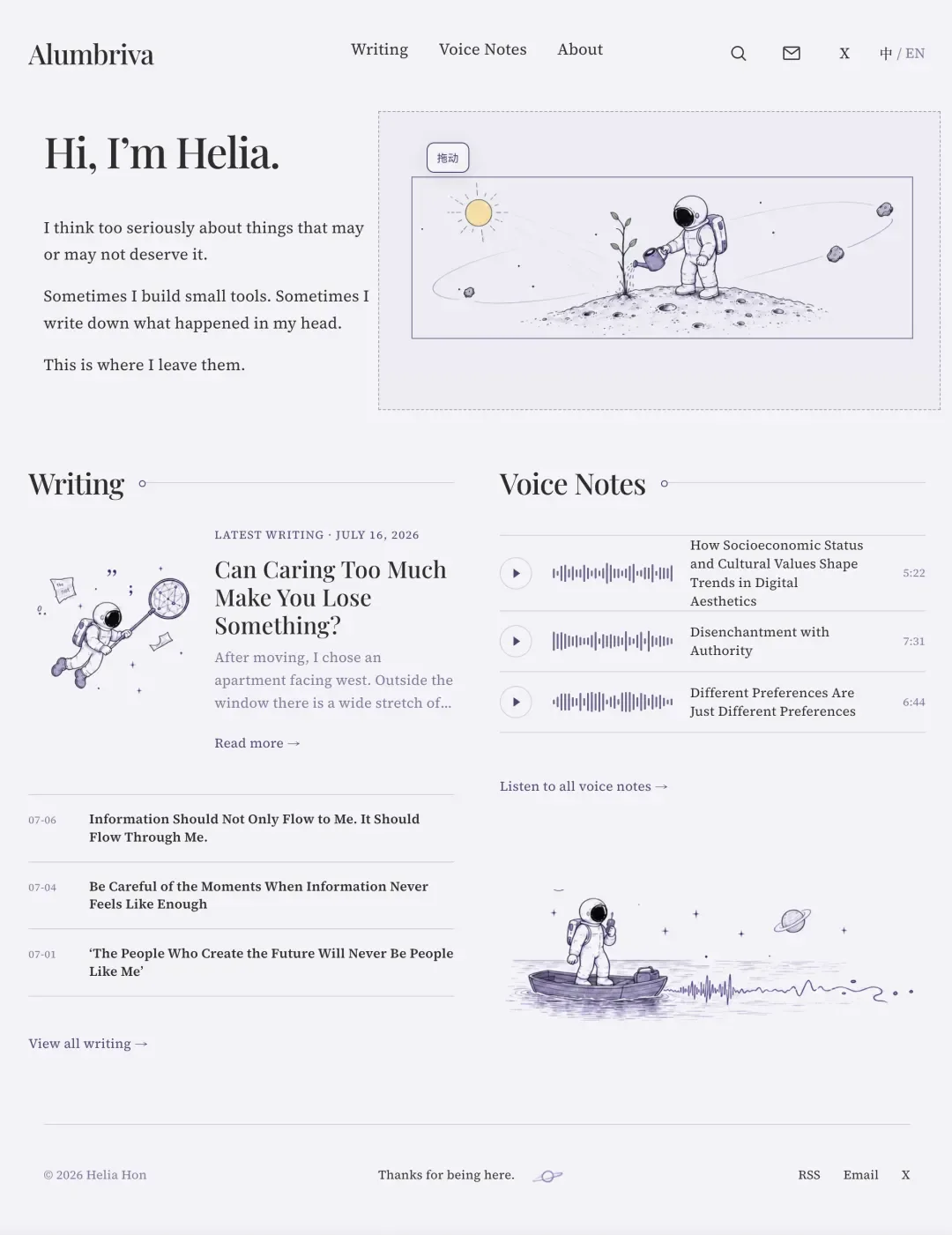

A lot of details are hard to describe in words. Also, I don’t know how to design and was too lazy to draw a sketch, so I asked Codex to design a layout editor for me—the result is shown in images 2 and 3 (yes, the “detail” I mentioned above is the selection box that appears with the word “Drag”~). You can drag things to adjust the distances between elements, images, paragraphs, and so on—whitespace, or what I think of as a sense of breathing room, matters a lot to me.
Codex handled the big direction, and I adjusted the details—image-generation models really, really, really need to think about editable outputs with layers, local locking, and pixel-level adjustments. That way, getting to a better result wouldn’t require… adjustment after adjustment without getting there 🥺
btw, this redesign used up more than a week’s worth of Codex credits (5.6 Sol on Medium)… I don’t know if I’m just terrible at saving credits 😂
But! Between having the idea for the redesign and finishing this result, there were so many adjustments and changes: from a vague first idea to gradually becoming clearer about what the blog should look like; from not knowing how to make a model accurately guess the whitespace and gaps I wanted to designing a layout editor from scratch, then slowly adjusting it to fit my rhythm and make finer adjustments easier…
I keep thinking, if the interface Codex generated had looked like the Canvas interface or a layout interface in a design app from the beginning… wouldn’t that have been nice!
So, as I said above—I hope image-generation models will consider editable outputs with layers, local locking, and pixel-level adjustments. That way, when I ask Codex to design images, I can burn fewer credits. The same goes for using ChatGPT to make images; it could save some OpenAI compute too (…right?)!
Oh wait! Using fewer credits probably can’t become a model-improvement strategy for vendors. Then let’s change it to “give people back the fine-grained editing control that should belong to the human in the loop when working with AI”?
I’m quickly writing this down before today ends. When I have time, I’ll look back in detail at how I actually made it (and include pictures of the original version!)
Although this blog looks a little pink and a bit like a fairy-tale picture book… never mind, it’s good this way too!
The link is here: lumihelia.com (or scroll to the bottom of the article and click “Read more”)—the content still has many details I haven’t handled yet, and I’ll keep improving it over time~
Finally! Let me find myself a little more work~
If any of you are still only half-familiar with coding agents (or working with AI), especially if you have no technical background, and need a little help—feel free to reach out!
I want to share some of the useful and useless skills I’ve kept here with people who need them! 👀
And if my support really helps you, maybe we’ll meet someday—you can buy me ice cream~ 💜
P.S. A record of the original version, though sadly without the pictures: click here.