I wonder whether parts of everyone’s everyday routines work like this:
To watch a video, open a video app;
To listen to a podcast, open a podcast app;
To listen to music, open a music app (although music and podcasts have mostly been gathered into the same app now, there are still relatively few activities related to music and podcasts that all happen on the same platform...);
To shoot a video, use one app; when editing, open another;
To draw, use one app; for layout or a composite design, switch to another;
Research and due diligence are even more of a “battle of wits” with the information I need, moving between and dealing with different apps and media...
Now go look at the word “App” again. Do you ever feel, “For heaven’s sake, if I have to look at these three letters one more time, my eyes can take it, but I’m out of here”?
Anyway, the “apps” above can be understood in a broad sense; they also include websites and web pages.
In other words, to complete one thing, I usually have to switch between several platforms. Leaving aside how much time that wastes, the friction of moving across platforms inevitably affects, to some degree, both my efficiency and my willingness to finish the thing.
When making plans to go out with friends, someone might say: I want a destination with food, drinks, entertainment, skincare, manicures, shopping, and a mall... and, importantly, the different stops should be within walking distance of one another.
Isn’t a “mall,” in the modern sense, basically all of the above in one place? It is.
But if the area has several one-stop malls, which one do we choose? Then we have to keep analyzing the need.
Coming back to the point, China is genuinely good at “bundling” things like this, integrating as many related or unrelated independent ecosystems as possible. Take WeChat: Moments are for socializing with people you know; Official Account content creates value links with strangers... Besides people’s relationship networks, it also offers entertainment (games, videos, music, and so on), bill payment, shopping, and even ride-hailing, food delivery, and browsing an online supermarket...
Users can enjoy as many services as possible within the ecosystem. It not only saves time, but also reduces (for some users) the cost of making decisions—people tend to consider what is right in front of them, and things that are more visible also tend to feel more trustworthy. 🧐
I once proposed the idea of a podcast AI knowledge base that could precisely locate and index things, help me search for podcast content related to whatever information I need, and accurately lead me back to the original source.
But then I thought: getting podcast information alone isn’t enough for me. There are other media besides audio.
So could there be something that lets me access information from across the internet all at once, as accurately as possible?
I became a Perplexity user not long after it launched, but now I can’t even remember the last time I used it. I turned to other tools. They don’t just search; the information they give me goes far beyond listing the requested information and its source. The problem is that the source links they attach don’t always lead anywhere. Whether a piece of information exists at all becomes a complete mystery. By comparison, Perplexity’s results are more accurate. But I still gave it up. Why? 🧐
In the AI world, creators of text, audio, video, and images each have their own preferred combination of creative tools. Once the needs are defined, the next step is to find those tools and start to co-operate (collaborate). But the problem is that the interaction surface between tools usually requires switching. Even with the same interaction surface, such as a browser, there are different functional interfaces inside it, and we still have to open different views to keep using the relevant functions. Or we have to build the integrations ourselves and combine them into one: a text creator might choose a Claude Code + Obsidian combination to improve creative efficiency while building their own knowledge-base system at the same time.
So is there another possibility: that we only need one interface to fulfilll every need?
Put simply: completing three things by opening three interfaces VS completing three things by expressing three needs—or sending one message containing three intentions. That would be what a future operating system might look like. For now, let’s call it Model OS.
The idea of Model OS (a model operating system; “Model” here can be understood as the M in LLM, or as an aggregation platform for multiple models, such as multimodal models) gradually became clear to me through asking questions and interacting with AI, and I find it especially novel. I didn’t expect there to already be a conceptual pioneer in the real world: Andrej Karpathy, whom I mentioned in the article I’m linking to here, proposed LLM as OS (large language models as operating systems): a future operating system could use a large language model to call on all kinds of functional modules (or, you could say, the functions of all kinds of apps) to process human instructions. Put simply, Model OS would directly do what I want, instead of making me find tools to help me do it.
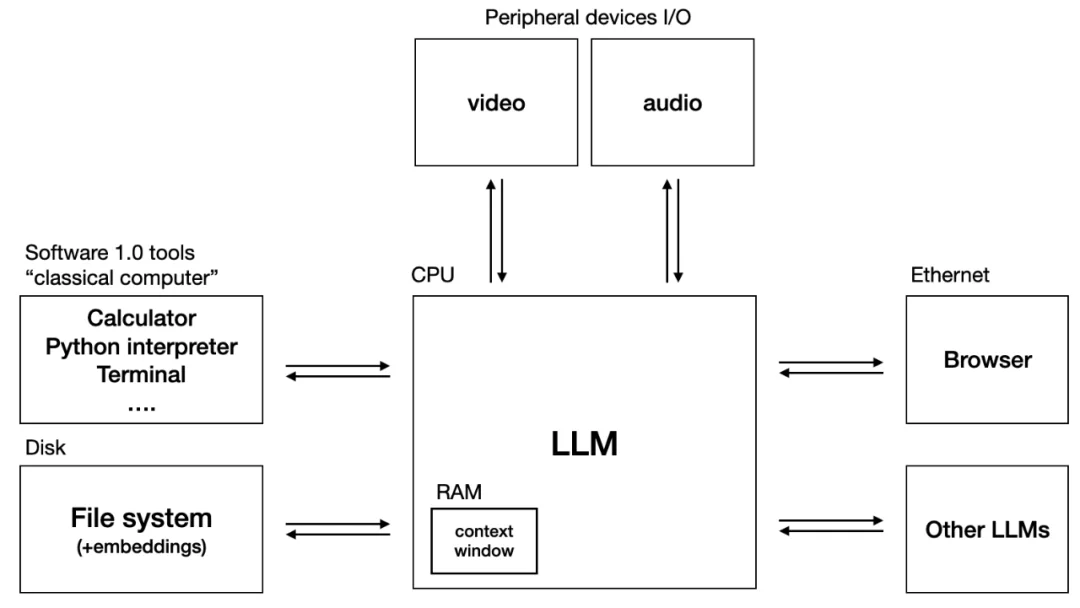
Here’s a video related to LLM as OS👇
By coincidence, today I came across this interview on “暗涌 Waves”: “Ling Universe Raises 200 Million RMB in New Funding to Build an AI World Operating System,” which mentioned Ling OS. I suddenly thought, Wait—why does this sound so much like the concept AI once “brainwashed” me into believing in?
I had the illusion that the future had already arrived, and I was standing at the center of the trend.
Anyway, back to the two places marked “🧐” above:
1. “People tend to consider what’s right in front of them / things that are more visible also tend to be more trusted” isn’t a law. In fact, shopping mini-programs inside WeChat are pretty useless; we still go to other apps. Games too: mini-program games have gathered quite a few users, but there are countless more outside. This shows that even if Model OS becomes real, specialized apps will remain mainstream.
In the future, most apps may become a kind of invisible presence, ready to be called up and used by users through intent, while still available to be opened directly. In fact, the future app ecosystem may have a lot in common with the ecosystem that has continued to this day—it will vary by culture and ethnicity, and from person to person. The difference is that, for users, Model OS would make production and creative work more efficient and convenient.
2. As for “why”: I think... if you work in research, analysis, or a related field, you probably find Perplexity extremely useful. I’m not that kind of user right now, so it’s no surprise I’m not an active user—this is essentially a PMF (product-market fit) issue.
Last but not least, I’m not sure whether this reality will arrive, or when it will arrive. I just found it interesting and wrote it down. There are still many factors I’ve overlooked, such as information security and class stratification. So let’s see how time proves it.
This note is basically over, but I want to briefly open up the direction of a future note. Anyone who has studied computer basics will recognize the two keywords in Karpathy’s diagram above: CPU (central processing unit) and RAM (memory, also called read-only storage).
Yes, next I’ll write about what I’ve learned about “biological computing,” what it is, and how it relates directly to CPU and RAM. I’m planting a flag here for myself!
Okay, see you next time~